
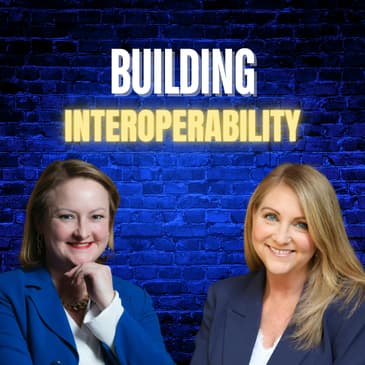
What would you do with a billion dollars to fix healthcare? For Sandra Johnson, SVP of Client Services at CliniComp, the answer is clear: solve interoperability, once and for all.
Rosa Hart sits down with Sandra to unpack one of healthcare's most persistent problems, fragmented data environments that slow clinicians down, create gaps in patient care, and quietly fuel burnout across health systems. Sandra brings 25 years of healthcare IT experience to a candid conversation about why interoperability is so hard to crack, what it takes to design technology that actually works for clinicians, and how CliniComp's System as a Service model is shifting the burden of implementation away from health systems so they can focus on what matters most.
In this episode:
Why interoperability remains healthcare's most foundational unsolved challenge
How fragmented data contributes to clinician burnout and care gaps
What vendor-agnostic interoperability means and why health systems need it
How CliniComp's System as a Service model removes the implementation burden from clinical teams
Why workflow integration is the real key to making data meaningful at the point of care
Guest: Sandra Johnson, CDH-E, SVP of Client Services, CliniComp 🔗 linkedin.com/in/sandra-johnson-cdh-e-a96b9a
CliniComp: clinicomp.com
Connect with Nurse Rosa:
Follow Nurse Rosa's INsights in the Health Podcast Library
Get the Book: Speak Up, Start Now ( Nurses Week Gift of the Year)
On social media: @NurseRosaSpeaks
Nurse Rosa's INsights is part of the Health Podcast Library. Subscribe, share with a colleague, and leave a review to help more healthcare professionals find this conversation.
[00:00:01] I want to talk to my fellow nurses for a moment because this is important. I just finished reading Speak Up Start Now by Rosa Hart, RN, SCRN. And I'm telling you, for once someone said out loud what so many of us feel every day in healthcare. That we're waiting to feel ready, to feel confident enough to believe that our voices matter. This book shuts all of that down in the best possible way.
[00:00:26] Rosa doesn't just write from theory. She writes from lived experience at the bedside, in leadership, and in rooms where real decisions are made. And she reminds us, page after page, that imposter syndrome doesn't get the final say. We do. Speak Up Start Now gives you the tools to step into your voice with the confidence healthcare desperately needs from us.
[00:00:50] I'm recommending this book to every nurse, every new grad, every leader, and every person who's ever felt like their ideas weren't enough. Because the truth is, healthcare can't wait. And neither can we. The change we want to see starts with our voice. Your voice. Do yourself a favor. Get this book. Read it. And then go speak up. And start now. Speak Up Start Now by Rosa Hart, RN, SCRN. Available now.
[00:01:21] Hello and welcome to the Nurse Rosa's Insights Podcast. I'm your host, Rosa Hart. And today I am joined by Sandra Johnson. Thank you for being with me today. Thank you so much for having me. I'm so glad to see you again. Yes, we met in LA at Vive about a month ago. And it's been a whirlwind since then, but I'm glad to get to have more time to talk to you now. Absolutely.
[00:01:46] Absolutely. So, Sandra, you are, is it the SVP of Client Services for Clinic Comp? Yes. I've been with our organization for almost 15 years now. I joined the organization after being a customer and wanted to come on and continue supporting this organization to make sure we're bridging the gap between what healthcare systems needs and what vendors can deliver.
[00:02:12] Yeah. And so before we got started, we were talking about how frustrating it can be when you are going back between different states or different hospital systems and you can't get the records transferred in any kind of reasonable time frame. So what is your experience been like that just as a person? Yeah. I mean, I've lived in four different states throughout my lifetime so far.
[00:02:40] And I can say that as I've started my healthcare journey, you know, I've seen specialists and, you know, had troubles starting a family. And when I moved states, none of that information followed. And so it was kind of starting over each time whenever I moved.
[00:02:57] And so, you know, really wanted to be a part of the healthcare industry and trying to solve some of those challenges that all of, you know, us face in a daily situation when we're navigating the healthcare system. Yeah. And we were talking about how frustrating that can be when you're the patient or the caregiver for a family member.
[00:03:21] And it feels like all these well-intentioned people want to help, but they're helpless when it comes to things they just legally don't have access to. Right. And or they can't get faxed over the super secure fax line fast enough. Yeah. That still cracks me up that we have to use fax machines.
[00:03:41] Oh, but so how else could you describe your work and the way that you see it making an impact on the human level? Yeah. I think we have to remember that technology is just a tool and at the core of healthcare is the patient experience and even the clinicians that are serving those patients.
[00:04:06] We need to keep the human-centered care front and center, making sure that technology is enabling them to have more valuable interactions. And so it's really, you know, being a part of the health IT community and making sure that tools and technology are enablers and not adding on complexity and layers.
[00:04:27] And so just really being a part of that ecosystem and trying to break down the barriers that we all face as end users, as part of the healthcare system, as clinicians trying to serve our patients. We want to eliminate, you know, that documentation burden that exists on our clinicians so that they really are having high-value interactions and really getting to know their patients and serve them in the best way possible.
[00:04:55] Yeah. And in the healthcare IT realm, it's been very popular to have a SaaS model, software as a service. But I heard you talking about a system as a service. Can you tell me what is different about that?
[00:05:13] Yeah, absolutely. So with our system as a service model, it's subscription-based, much like the SaaS model, but it includes everything that you need to implement and then optimize the product over time. So that includes hardware, software, and all of the support services. A lot of times people will play astronomical implementation costs for trainers and that support that you need to implement, but then they don't have those same resources post-implementation.
[00:05:41] And that's when you're really, you know, adopting the system and over time want to optimize it. There's, you know, constant changes to regulatory requirements, best practices, and really having a system and the support to iterate and evolve over time is really critical. And so we package everything that you will need at any point in time to be included in that system offering. So we want to make sure that there's no barriers to using the technology, to optimizing over time, to having the support you need 24-7.
[00:06:10] So it's really a comprehensive model that provides that predictable cost up front and allows you to budget and ensure that you have all of the support that you'll need throughout the lifetime of the relationship.
[00:06:26] And then since you are in charge of client relations, essentially in your position, do you talk to clinicians very often or are you mostly speaking with the administrators in these relationships? Both. I think in my role, I kind of sit between the executive strategy as well as the frontline clinicians.
[00:06:53] And I think what's really important is making sure that there's alignment and buy-in from the start. You know, the most important thing that you can do is listen. That's where you can really solve the problems. So technology, again, is just that enabler, but you have to make sure that all stakeholders within the organization are aligned. You have clear objectives of what you're trying to solve, what you expect the outcomes to be,
[00:07:17] and really having buy-in from all levels within the organization and making sure that that stakeholder alignment is there from the onset. Exactly. So what do clinicians most often tell you that they wish people that are building these technologies actually understood about what it's like to use it when they're under pressure?
[00:07:42] Yeah, I mean, I think everyone wants the system to really be more intuitive and aligned with their workflows and the reality of how care is delivered. So it's really making sure that there are practical use cases that are being addressed. And so when the system is being built, it should be designed around those specific workflows.
[00:08:06] And when technology or, you know, advancements are introduced like AI, it's embedded in those workflows. So you're not adding additional clicks or steps or, you know, parts of the process. It's just natively embedded in your workflow so that you can leverage those capabilities without any additional retraining, retooling. It's just at the point of care.
[00:08:30] So really just making sure that systems are designed based on how clinical delivery is being executed. And I don't know how much you're on the front lines with that or if you have a team of people that is in charge of all these conversations, but do you kind of serve as a translator between like the clinician side and the IT side? Yeah, absolutely.
[00:08:56] One of the great things about Clinic Comp is that we have clinicians embedded within every department within our organization. We want to make sure that our end user community is front and center as we're developing and iterating the product. And so we never want to lose sight of the clinicians and the challenges they face and what we're trying to solve. And so we have clinicians that are part of the software development lifecycle as well as the implementation teams and out there helping organizations optimize how they use the system.
[00:09:25] And so really making sure that you don't lose sight of those that you're trying to serve is very important to us. And so it's really important to have that peer-to-peer conversations when we're understanding the workflows, when we're training to bring that feedback internally of how we can continue to iterate and develop the problem to meet their needs. And having that peer-to-peer conversation so there's true understanding and then being able to translate that back to the engineering side as well.
[00:09:53] So really having that conduit that can then represent the customer's needs and the technical requirements is critical to make sure that we're actually meeting the needs. And when we say clinicians, are we talking about just physicians or physicians and nurses? Or how many different kinds of clinicians are involved in these processes? Yeah. I mean, we try to have as much of the care team represented as possible.
[00:10:20] So while our nursing community within our organization is the most robust, we also look at having experts on the ambulatory side, the ancillary products that we support, as well as the provider voice. So really making sure that you have a well-rounded representation of those that are utilizing the technology is important. Again, to just make sure that you're really designing a system that is going to meet the real-world clinical challenges that are faced.
[00:10:50] Yeah. And I think it's really interesting to me coming into the health IT side of things because the word clinicians gets thrown around really generously. And in nursing circles where I've spent most of my career, we don't necessarily identify as clinicians. Clinicians seems to be more synonymous with prescribers.
[00:11:16] And so I'll see things that say, you know, including clinicians. And so as a regular nurse, I would assume they meant doctors and maybe nurse practitioners. But I've come to realize that most of the time they're talking about like the whole interdisciplinary team of anyone who is touching a patient or interacting with the patient and providing that direct patient care. Would you say that's what you mean when you say clinician?
[00:11:46] Absolutely. Absolutely. And I also don't want to stop at just clinicians. There's obviously a lot of administrative support, especially on the RCM side. And so really just having the expertise in any of the areas that comprise caring for a patient. And that includes, you know, the whole registration to billing, making sure that you have the right subject matter experts that are providing that consultation is very important.
[00:12:17] Definitely. And so if there's a nurse listening to this that feels like technology is working against them instead of for them, what would you want them to know about people like you who are actually trying to do things to make it better for them? Yeah. Yeah. I think the voice of the customer is so important.
[00:12:37] And so, you know, I really just challenge everyone in their role to really be an advocate and vocal about the challenges they're facing, their ideas. I think all ideas are good ideas. They might be solved in different ways. But knowing what are kind of some of those pain points that people have developed workarounds for, you know, never accept a workaround. Be vocal.
[00:13:06] Let everyone know what is and isn't working. And that opens up the conversations to really innovate to solve the real world challenges. So I really just would empower everyone to speak up and make sure that your perspective and opinion is heard. We can't solve what we don't know. And so really just bringing that that voice to light is important. I'm so glad to hear you say that. In fact, I wrote a book about how glad I am to hear you say that.
[00:13:35] Because I think you're right that workarounds are not something to settle on. They are to showcase that this can be done better and that people who can develop workarounds are just creative enough to build sustainable solutions. So I'm really hoping to see that done more.
[00:13:53] And this brings us to the billion dollar question that I ask everyone on the Nurse Rosa's Insights podcast, which is, Sandra, if you were given a grant for $1 billion to meet a need you see in health care, how would you like to see it used strategically to have the most sustainable impact? Well, I think interoperability still remains one of the biggest barriers that we have in health care.
[00:14:21] And so that's where I would like to see a grant of that size applied. You know, until we have really fully connected care, we're not going to be able to deliver the results and really have the true advancements that we want. I think there's so much fragmentation between systems and data, and that's really challenging when you're trying to have a holistic view of the patient to really make sure that you're making informed clinical decisions.
[00:14:48] And so being able to normalize data across disparate systems and serve up the data in meaningful ways that truly provides a holistic view of the patient, that's what's really going to make an impact. And so that's where I would like to see, you know, a grant of that size be applied to really make a lasting impact. Yeah, definitely. And how do you think it could best be used to do that? Like, what are the barriers?
[00:15:13] Is it really that we don't have the technology or is it that regulations are in the way or is it that companies are protective of their proprietary data and they don't want to share it? Like, how can we allocate a billion dollars to do we need to use it to convince people or to develop new technology or to lobby to change laws?
[00:15:39] Like, what are the barriers there that you see? Yeah. I mean, I think everything that you mentioned plays into those challenges. But I think if we could really invest in building a scalable infrastructure, that's going to deliver the seamless care. And so if we can have real-time data exchange, regardless of what platform it's sitting in, that's what's going to make a difference.
[00:16:03] So really just having a scalable infrastructure that can support the data sharing, having modern APIs, regulations that drive organizations to adopt that will really help incentivize and make a shift, I think. So, you know, I don't think it's one thing is going to solve it. So I think it's a combination of regulatory and, you know, scalable infrastructure. Yeah. Excellent.
[00:16:31] Well, thank you so much, Sandra, for joining me today on the Nurse Roses Insights Podcast. So if anyone is listening to this and they want to connect with you and learn more about your work at Clinicomp or how they can join you to build a better infrastructure for interoperability, is LinkedIn the best place to find you? Yes. Clinicomp has a LinkedIn page, and you can reach out to me directly through LinkedIn.
[00:16:59] And, you know, we're just excited to be a part of this industry where we're offering an EHR that's designed around clinical workflows to free up that administrative burden. So if any of this resonates with you, I would love to continue the conversation. Excellent. Excellent. And for our listeners, if you enjoyed this episode of the Nurse Rosa's Insights Podcast, please like and subscribe wherever you're listening. Feel free to follow me on all the social media platforms at NurseRosaSpeaks. I'm also on LinkedIn.
[00:17:28] Or you can look into having me come speak if you are having an event for nurses or other clinicians, as we talked about. I am giving a keynote related to my book, Speak Up, Start Now, that is very on topic for our conversation. And so I hope to hear from you. So leave a comment. Let us know what you thought.
[00:17:53] And if you have ideas on how you would use a billion dollars to build a better health care. And I will see you in the next episode. Thank you.