
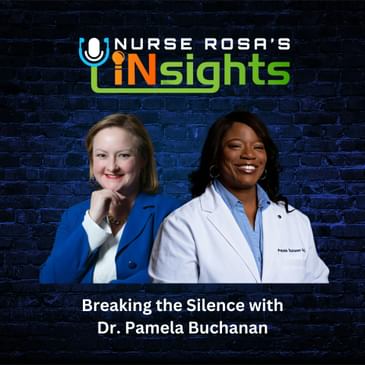
🎙️ In this compelling episode of Nurse Rosa's Insights, Dr. Pamela Buchanan, an experienced emergency room physician, opens up about the mental health struggles faced by healthcare workers, particularly during the pandemic and the solution she envisions that can turn the tide to keeping clinicians in the workforce.
💡 Key Takeaways:
🚨 Shocking statistic: One physician dies by suicide every day.
💔 The emotional toll of working in high-pressure environments like the ER.
🌟 How coaching helps healthcare professionals reconnect with their purpose.
🛠️ The urgent need for systemic changes to support healthcare workers.
🧠 Why mental health resources must be normalized in the medical field.
👩⚕️ Mandatory counseling after traumatic events can save lives.
💬 "You're never trapped. You have so much power."
🔍 Discover:
Connect with Dr. Buchanan at:
Find Dr. Buchanan on social media @StrongMDstl
or on LinkedIN at: http://linkedin.com/in/pamela-buchanan-md-61ba5562
The role of the Lorna Breen Heroes Foundation in preventing physician suicide.
Practical steps for healthcare workers to advocate for their own well-being.
💪 This episode is for:
Medical professionals navigating mental health challenges.
Leaders seeking to create supportive healthcare environments.
Advocates for systemic change in healthcare.
🎧 Listen now to learn how we can all take part in improving the well-being of the heroes who care for us.
👉 Don’t forget to subscribe and share with someone who needs this message. #HealthcareHeroes #MentalHealthMatters #PhysicianWellness
[00:00:11] Hello and welcome to the Nurse Rosas Insights Podcast. I'm your host, Rosa, and today I'm joined by Dr. Pamela Buchanan. She is an emergency room physician, speaker, and a coach now. And she's going to share her journey with us through these stages of career from her personal story. So thank you so much, Dr. Buchanan, for joining us today.
[00:00:38] Thank you, Rosa, for having me. I appreciate that. So she already said my name is Dr. Buchanan. I'm family medicine trained and I've always moonlighted in the emergency room. And so I've been doing emergency room most of my career. And because in primary care, I was working just a little bit in the ER, making more than working six and seven days on primary care. Plus in the ER, you don't have to bring the work home.
[00:01:02] So I'm a St. Louis in Missouri born and bred. And the way I grew up was when I was young, questions were raised about whether or not I had a learning disability. And so, but they weren't so kind. They would say things like, well, is she slow? And that's kind of a question my mom got often. And she would say, no, she just learns differently. I thank God that my mom was the way that she was because she was a staunch advocate.
[00:01:27] When I was tested, I found out that I just learned differently. And back then they called it Asperger's. Now it's autism on the spectrum. So high functioning autism. And, you know, it didn't have ADHD as well. So ER suited me because it's fast paced and you focus on a big major thing one at a time. And that was great for me. And I never had any issues until the pandemic.
[00:01:51] The pandemic was so stressful for anybody involved, especially if you worked in the ER because nobody else was working for us. So imagine this, you're working outside of the scope because cardiologists aren't working, surgeons aren't working. So you're just trying to keep people as best you can in the emergency room. And the sheer volume, the volume got to be just unimaginable. It was like, it was like a war's off.
[00:02:18] And the sounds, and for me, those sounds became kind of the soundtrack of my trauma. They were so annoying. I couldn't shake them. I heard them in my sleep. I heard them when I was driving up and pulling up. It just seemed kind of triggering. And so just the sheer magnitude of working 80 hours a week, sometimes even more and not sleeping much and worrying about myself, worrying about my family, worrying about if anybody would get sick and die or worrying about if I did the right thing for each patient I saw.
[00:02:48] Whenever I lost one, I worried about if I was doing the latest protocol and the protocols were confusing because things were changing so fast. So I became depressed. And I knew this because I would drive past a bridge. There's only one, I live across the river to get to work. So I have to drive over this bridge every day. And I started to feel like I wanted to jump in. It was just a thought. And then it became more of a loud thought. I shook it off until I heard about one of my colleagues that helped train me. He committed suicide.
[00:03:18] And you would never expect it because he was so happy outwardly. And so that's when I started to get help. And I realized, you know, that I was suicidal and depressed. But for a physician, that's not hard. That's hard to admit. We don't want that on our records. There's many places you can lose your license for that. So that's why it just took so long to get help. I did because that's probably the only reason I'm here. I realized how messed up the health care system is from a mental health standpoint.
[00:03:44] And otherwise, as we've all heard lately, because my insurance didn't cover it. I had to pay for it out of pocket. And if I wore it. Wait a minute. Your insurance? Your physician and your own insurance didn't cover you getting counseling? I mean, we have the same insurance as everybody else. I mean, we have Anthem. We have Aetna. We have... That's not the first time my insurance hasn't covered something. I can recall my son had the flu and it was denied for pre-existing condition. The flu. And I called him.
[00:04:14] Oh, it's a flu, a pre-existing condition. What? I spent two hours on the phone and I knew the ICD-9 code and just being a physician, I think, was what helped me get it overturned. I was like, there's no way that an influenza can be pre-existing. It's an acute illness that's either self-limiting or treated with Tamiflu. And so I was able to get that fixed. But that, yeah, that's insurance for you. And it's not new. Age is only time. But that made me see something.
[00:04:41] I used to loathe when people came to the ER with mental health problems. Like, well, hey, this is not where you're supposed to be, especially if it wasn't acute. Because their insurance wouldn't cover it. Yeah. They're just reaching out. Where else are they going to go? Trying to get a lifeline. And so I'm lucky and blessed. I was able to pay cash and it was a long time. I spent thousands. And I still do. I still pay cash for mine. I pay cash for my daughter's. Insurance doesn't cover it well. Yeah, exactly. And I really appreciate you being willing to share your story.
[00:05:11] I got to listen to your TED Talk that you gave in Virginia. And it was so amazing just to hear your story and your context. I think a lot of people have experienced similar going through burnout. Whether, like, I experienced burnout before COVID. So I can't even imagine what all you went through. But you and I were talking outside of this. And I was like, I would love to meet a physician who has not experienced depression.
[00:05:38] Like, you get to see people on the worst days of their lives. And it's really hard to see, you know, the best case scenario when you're always looking for the worst case scenario. Right? Yeah, so the more I talk for different positions, it's different things. I was just at a function last night. It was a funeral. But a lot of my friends were there. And I was talking to a neurology friend. And she was saying that she deals mostly with ALS. ALS has no cure.
[00:06:05] And if you think about it, you're seeing people every day that you know are going to die. There's not much you can do to change the trajectory, kind of keeping them comfortable. And she says it's hard every time. And I never thought about that, just dealing with, you know, I imagine the same would be true for an oncologist or, you know, people who do high-risk surgeries that usually don't have a favorable outcome. So there's so much stress when you are dealing with someone's actual physical well-being or their life.
[00:06:34] Or you also think about whether or not your actions could cause them disability. So it's kind of like a weight on your shoulder. And, you know, physicians feel this. Nurses feel this. We all are there with the same goal to help them. And as you and I were discussing earlier, a lot of people said they were thankful for us during the pandemic when we were the heroes. But there was a lot of taking us for granted in that we're humans, too.
[00:07:02] And it's hard on our hearts to see all the suffering every day and feel that compassion and want to fix it. So thank you for, you know, bringing, being brave and sharing your voice for this discussion. Was your hospital able to, like, implement any more supportive policies after that? No policies.
[00:07:25] Because my hospital has enacted, like, they give 10 free mental health visits for each employee and every member of their family per year. And that is something that we have taken advantage of and I'm so thankful for. So anytime an employer can provide support like that, just letting you know there are places that do it. So if anybody wants to copy that, go right ahead. That sounds like an excellent benefit. So I would tell you this.
[00:07:54] My employer had EAP visits, so employee assistance plan visits. Yes. And there's four of them. You get four. So when I called the back of my insurance card, nobody was accepting that. And I understand why. Because I was an investor in a mental health practice for a while. The reason I'm not anymore is because it lost hundreds of thousands for me. It did not make any money.
[00:08:19] So EAP pays about half, sometimes a third, of what regular insurance would pay. So many practitioners don't accept it or they accept it kind of as a lead magnet, meaning I'll accept it hoping that you'll continue with me on your regular insurance. And so that's the problem with EAP in my area. It's interesting.
[00:08:45] I've used BetterHelp as well, the app, when I needed something more immediate. Because a lot of places you call, it'll be months before you can get an appointment. If you're paying cash, paying with insurance, whatever, just they're booked out. There's not a whole lot of availability. And you know what? That's the case.
[00:09:06] And when I had a practice and had a therapist working under me, it would be that it was, it's just a computer trying to figure something out. It would be that the day, maybe if you went Thursday at four o'clock, we don't have Thursday at four o'clock for six weeks. But we do have Thursdays at two. But since computers and algorithms can't figure that out. Well, that is frustrating. It is. So you were able to take your experience and then start speaking about it.
[00:09:35] And you started coaching yourself now, right? Right. So, you know, I didn't even think about it too much until it happened to me. And that's how like a lot of things go on in my life. Like whenever I have some kind of illness, I'm more sensitive towards patients who have it. I didn't think about physician suicide. But the fact of the matter is that one physician a day commits suicide. So that's about, you know, three to four doctors per year. That's a whole medical school class. So each year we're wiping out a medical school class.
[00:10:04] Graduating the medical school class and wiping out another one. That does not seem sustainable to me. I have so many nurse colleagues and physician colleagues. I read this hat that said 41% of the workforce left after COVID. I don't think that's sustainable either. And so I just thought, you know, so I had better and I got reconnected to purpose. And I was, I realized I needed to work less. It just worked differently in order to sustain my mental health. Then I realized that a lot of us need support.
[00:10:33] Most of us even. And I went to therapy, but coaching helped me more because the coach understood in a specific way what a doctor goes through. And so for that reason, I felt so much gratitude. And I was like, I'd like to do that too. I kind of already have, I do do it, but I want to get formally trained. And so that's how I got into physician coaching. People come to me for advice. I give good advice.
[00:11:03] So I was like, let me get formally trained. Yeah, exactly. And you can bring that up. There's so many things that we have a hard time explaining to people who have not worked clinically at the bedside with the populations that we've seen with the level of suffering we've seen every day. That's like our norm. Or I think you were describing some really intense scenarios from the ER that, you know, like, I don't know if my therapist can handle hearing the gory details, but it stuck with you. Right.
[00:11:33] Because you had to remember your worst calls. And you're going to remember specifically someone that resonated with you that reminded you of somebody you know. Or if you see yourself in someone. I can remember a call of a woman who had some children and she was with her husband. They were just on vacation. They had an accident on the highway. I was like, that's so something my family would do. And she was the only one who was hurt. She unbuckled her seatbelt to cover her daughter so she wouldn't get hurt. And she got a terrible head injury.
[00:12:03] And so that one stuck with me more. And it happened on 4th of July. So I tend to think of her every 4th of July. It's been about five years now. So, you know, that or I remember one COVID patient that was a guy who in the ER, some patients can tend to be almost like your patients because they don't have insurance or they use the ER a lot. He had asthma. He used the ER a lot. And I saw him and, you know, we sent him home. He had an inhaler. We treated him, said, you know.
[00:12:32] If it gets worse, come back to the ER. I was off on a day and he came in on the day where I was off. And he was a young man. He was like in his 30s. But he had asthma that he wasn't managing appropriately because he didn't have any money. And he did die of COVID complications with his asthma. And I felt so bad about that one. But even though I know it's not much I could have done about him being able to take care of his COVID or his asthma more effectively.
[00:12:58] But the thing of it is we take this in and we think with every patient, with every loss, was that my fault? And I know too many doctors who don't think like that. I've definitely heard that a lot. And I want to thank you for your service. It makes a huge difference. It really does. As a nurse, I have seen the impact of all the people who do get better, especially now on the outpatient side.
[00:13:22] And I hope you're able to see some of ways people get better as you are speaking to more people and able to do this coaching and stuff and take it outside of an emergency situation. Yeah, I think it's important. I think nurses need coaches. I think doctors need coaches. I think it's important that someone is there to speak to the new generation, new doctors and nurses, and try to get them to pace themselves like a marathon instead of sprinting.
[00:13:49] And as a hospital will press you to do, that's not sustainable. You will not run full on during the marathon. You would pace yourself at a certain pace. And that's kind of how your career should be. And there's joy in medicine. Reconnecting with your purpose and really getting back to the why of why you do this can help you reconnect and sustain yourself and love what you do. And also realizing that there's multiple ways of doing what you do. There's so many ways to be a nurse. And there's so many ways to be a doctor. So these are things that I don't speak about when we're in training.
[00:14:19] And those are the things that I do when I coach people. Yeah, it's good to have hope and not feel trapped that this is the only way I could be a nurse or this is the only way I can be a physician. You're never trapped. You're actually, we have so much power. But there has been, I don't know, some type of brainwashing. Some story we tell ourselves that we don't have power. And you're never really trapped. You have a whole nursing degree, a whole medical degree. There's no trap. Yeah. There's only opportunity, really. Yeah, exactly.
[00:15:18] People may be able to suspect your answer based on your story. But if you were given a grant for $1 billion, how would you like to see that used to meet the needs that you see and have the most sustainable impact? The one thing that I see is missing in health care is caring for those who care for others. And so we need to do a better job of caring for nurses and caring for doctors.
[00:15:42] For instance, my friends who come to the ER and bring me the patients are the paramedics, sometimes firefighters or policemen. And when there's a hard call, they get mandatory counseling. I'll see that they're not coming in for a few days. And where are they? They had to sit out until they get counseling. And the counselors said they were better. And so the same thing, I'm seeing the same things they're seeing. There's no counseling for doctors. There's no counseling for doctors or nurses who work in tough situations like critical care and ER.
[00:16:11] And you all know those are among the toughest. Oncology even. And I think there should be. I think it should be mandatory. And I think it should be embedded in the hospital system. There should be group coaching. There should be group therapy. And there should be specific therapy when you have seen something extreme. It should be automatic. It should be mandatory. Now, there's some start and some groundswell to that. In 2022, there is a bill passed at all hospitals. There's health care systems as opposed to have physician suicide prevention.
[00:16:43] And I don't see it implemented much except for in the form of a poster saying, if you need help, do this. And that does meet the criteria. I would like to see them do a better job. So my pie in the sky dream is that that would be implemented in every hospital system. And if you had extreme difficulty, there'd be a specific, you know, like a physician wellness center that you can go, like when you go get a rehab. Just to rehab and reset.
[00:17:10] And so that more of us will stay in practice. You know, it used to be you would be a doctor and stay in practice until you were 65 or so. And now people are quitting at 40. You know, 10 years of practice and they're quitting. And that's not good for society. Well, if they feel like they can't even be honest about the state of their mental health or they're going to lose their license, then that's their income. Right. And so it's this catch 22 of, you know, how can I be honest and get the help that I need?
[00:17:40] So normalizing the need, because honestly, it's normal to need mental health for your from your community, from the community of people who get it and from people who are prepared with how you can cope in a healthy way. So you don't get stuck in a negative mental spiral, but teach you how to rest and recuperate and then go back into the work that gives you so much purpose and meaning.
[00:18:09] And you can see why many people don't get help because you're a six-figure earner. It's not like if you lose this job, working at Walmart will cover things. And so you're a six-figure earner. You have a family, you have a mortgage, probably student loans. And this is how you live. So when I initially got therapy, I asked my therapist not to write depression on my paperwork,
[00:18:33] to say adjustment disorder, because I could not afford to have the board questioning me or have the possibility of losing my privileges. And that's something that the Lorna Breen Foundation, which is a place where I'm an ambassador, is starting to change. I think right now, you know, maybe almost half of the states no longer put that language on the licensure application. And so that's a step in the right direction. And what was the name of the foundation you mentioned? Lorna Breen Heroes Foundation.
[00:19:02] It's a foundation that works to prevent physician suicide, but we also work in general for healthcare workers, nurses, too. Okay. Well, I'll put a link to that in the show notes as well so that anybody who's interested can find out more about it and hopefully get some more implemented at wherever they're working. Yes, that group makes me hopeful and, you know, partnering with different groups.
[00:19:27] I'm just now getting into the landscape of all the different groups that do work in this area because everyone's so siloed. And I think that we need to figure out who's doing what and try to make it more of a cohesive mission. Yeah, exactly. Strengthen numbers. I agree. I agree. Well, thank you so much. And we met via LinkedIn. We just kind of resonated with each other on there. Our hearts are telling the same story. So thank you for reaching out.
[00:19:57] And so is that how you would like people to reach out to you? Or do you want to share your website as well? Yes, have me on LinkedIn. Or my website is drbstrong.com. That's a pretty epic name, by the way. It will be linked in the show notes as well. So if you have enjoyed this episode of the Nurse Rosa's Insights podcast, please subscribe wherever you're listening. And share this episode with a friend.
[00:20:23] If you know someone who is struggling with how to handle their mental health, hopefully they can find some resources this way. Or at least know they're not alone. This is a very normal thing to go through. True. When I was pre-COVID in the ICU, I think I was the last person on my unit to finally get on antidepressants. So it was very normalized for us.
[00:20:47] So just definitely don't be afraid to ask for help and reach out because odds are your coworkers understand. So. All right. Well, thank you, Dr. Buchanan. Thank you, Rosa. And the rest of you, I'll see you in the next episode.