
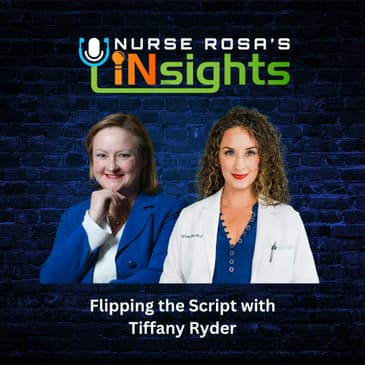
In this episode of Nurse Rosa’s INsights, Rosa sits down with Tiffany Ryder, MHS, PA-C, sharing an inspiring journey from NFL cheerleader to healthcare professional. They dive into the importance of patient education, informed consent, and how lifestyle changes can transform health. Tiffany shares personal experiences that fueled her passion for medicine and her mission to empower patients with knowledge.
Key Takeaways
- Tiffany’s firsthand experiences with the healthcare system shaped her career path.
- Personal health challenges motivated her to advocate for lifestyle-based interventions.
- Small lifestyle changes can lead to significant health improvements.
- Informed consent is vital—patients should fully understand their treatment options.
- Early education on healthcare systems can empower future generations.
- Social media is a powerful tool for spreading health information.
- Healthcare professionals should encourage patient curiosity and informed decision-making.
- Understanding the risks and benefits of treatments leads to better health choices.
- Private practice offers opportunities for more personalized and patient-centered care.
- Collaborative healthcare approaches enhance patient education and outcomes.
Tune in for an insightful conversation that highlights the power of knowledge in shaping better health.
Connect with Tiffany and follow her work:
https://www.linkedin.com/in/tiffanyryder/
Connect with Rosa: https://linktr.ee/nurserosaspeaks
Follow Nurse Rosa @nurserosaspeaks on social media
[00:00:00] If you believe advocating for your health is important, but not always easy, you're going to love Speak Up For Your Health, hosted by Dr. Arkel Giorgio. On Speak Up For Your Health, Dr. Giorgio talks with patients about how they overcame feeling intimidated by today's complex medical system and how they use their voices to finally get the care they need. You'll hear real and personal stories like Marielle's 11-year journey to diagnose a medical mystery. Why navigate the complexities of healthcare alone when Speak Up For Your Health can guide you?
[00:00:28] Listen and follow Speak Up For Your Health on your favorite podcast app, and you can find all the links you need at healthpodcastnetwork.com slash speak up. That's healthpodcastnetwork.com slash speak up.
[00:00:52] Hello and welcome to the Nurse Rosas Insights Podcast. Today I have a fellow podcaster on as a guest. Welcome, Tiffany Ryder. Hi, Rosa. Thanks for having me. I am so glad to have you on today. I've been wanting to meet you since we met online. So... Yeah, it's so cool to finally get a chance to talk to people that you feel like you already know from social media. Right.
[00:01:21] This has been a great experience. So thanks for, you know, inviting me so we can have a chat. Yeah, definitely. So I wanted to talk to you here in this format because you're definitely what we would call a healthcare stakeholder. If you've listened to this show before, then you probably know that, I mean, all human people can be healthcare stakeholders. But Tiffany has a really interesting journey. She went from a young mom to NFL cheerleader to now a physician associate.
[00:01:49] And she is doing a lot of similar work to what I'm doing as far as health messaging on social media. And that's a really important tool. So we have some things in common there, except I definitely was not ever an NFL cheerleader. I'm sure you did some other interesting things that you get into on the show. Well, I don't think I get into it. My first bachelor's of arts was in singing, like opera.
[00:02:18] Very cool. There's that. But you know why I didn't go into it? Tell me. I didn't want to be a starving artist because I thought I wasn't pretty enough to get cast in things. Oh, gosh. And now I'm putting my face everywhere. I know. And here we are. Yep. That's so funny. Before we got started, I asked if I could frame the question this way. You may be familiar with the show House. And in it, he says he hired the female doctor because she was so attractive.
[00:02:48] And at first she got really offended. But then he said nobody that beautiful goes into healthcare unless they're damaged. So, Tiffany, can you share with us your story and what leads to why you're so passionate about healthcare? Absolutely. First off, thank you. That's very flattering. And I feel like the older we get, the more flattering it is when someone needs to card you with the liquor store or says something nice.
[00:03:18] So, yeah, thank you. But, you know, it's absolutely true. I think it's true for most of us that go into healthcare that there is usually a story behind why someone's willing to put themselves in that position and do that type of work. For me, it was growing up in a community that really most people in the community weren't insured, didn't have access to healthcare at all.
[00:03:48] And really had, I don't know a better way to say it, but had sort of a low level of understanding of how to navigate the system and how to get the help that they needed. And it was a really vulnerable place to be. And for me, when I was in high school, my brother had a situation and got really sick and ended up in the hospital.
[00:04:13] And I remember getting the call and going to the hospital to pick him up and sort of being handed this packet of papers. And the hospital telling my mom and I, well, this is the medicine that he needs. This is the treatment that he needs. And it's all really important. So make it happen. And best of luck. And, you know, we really didn't know what to do. I was a child. My mom was actually a nurse. She was an LPN.
[00:04:43] But even as a nurse, you don't necessarily understand the dynamics of healthcare billing and or how things outside of your niche work. I mean, none of us do.
[00:04:58] And that was the place that she was in where she was working her job, taking great care of her patients, but wasn't in a place where she really had this comprehensive systemic knowledge of how to navigate things and being uninsured and being poor. We really struggled and had difficulty with that. And my brother did not do well and has not been in contact with us. We don't really know where he is or what happened to him.
[00:05:27] And that's a, it's a real source of pain and difficulty for my family. And yeah, so it's like, you know, when I, when I graduated from high school and started looking at what was interesting to me, that was always in the back of my head. Like, you know, how can it be that so many of us just like really have no clue what's going on. I still don't know what's going on. One day when I grow up and I'm big, I'm going to figure this out.
[00:05:55] And, you know, maybe I can, maybe I can change that dynamic for some degree, some, some portion of the population. And so that was sort of in the back of my mind. But again, I had like barely graduated from high school and had really struggled and figuring out how to get from point A to point B was challenging. And so over time I had my own issues in the healthcare system.
[00:06:23] I had grown up on, you know, free lunches and some government assistance. And my nutrition was not at all dialed in. I was eating whatever that was in the school lunch and whatever was on sale at the bread store or what have you. And found myself really in a position where I was low energy, unhealthy.
[00:06:52] I had gotten pregnant at 18, had a little one at 19. And I remember going to the doctor after I'd lost my maternity weight and thought that, you know, things were coming together for me. And being told that I had, you know, polycystic ovarian syndrome and I had a blood sugar level that was not quite diabetes, but really elevated. And I said, you know, well, what the heck does that mean?
[00:07:21] Again, not being the human that I am now, but being, you know, this 19 year old kid that had come from a rural place and just really didn't know. And the doctor said, well, it just means like, I was like, well, does that mean I have diabetes? And she said, no, it doesn't mean that. But it just means that, you know, you'll be at this level for a little while. And then, you know, we'll give you some, some medicine. It was metformin was the drug that I had gotten a prescription for.
[00:07:51] And, and then, you know, one day you'll probably end up with diabetes and then we'll deal with that. And wow, that was the conversation, right? And like, you're just destined to be diabetic. I was like, okay. I mean, now, you know, mind you, this was 20 years ago, right? So there's some degree of difference in the way that we handle that now. But that was the story I got and sort of separate from that.
[00:08:15] So on a separate track at that same time, I was looking to figure out what the heck I was going to do with my life. How was I going to be exceptional? How was I going to distinguish myself and do something outrageous and fun and challenging? And I had decided that I wanted to try out for the NFL. And I tried out for three different teams that first year. I won't say what teams they were actually. But anyway, I didn't make it past the first round for any of them.
[00:08:43] And just to dial back real quick, were you a cheerleader in high school? I was not a cheerleader in high school, but I had been on the dance team. Okay. And that had been, you know, like a really great social environment for me. And I said, well, what the heck? Like, I can try this. And so, you know, I didn't know what happened. I didn't know why I didn't make it. I was disappointed.
[00:09:11] But like, for me, that was really the first time in my life that I'd ever been faced with something that was like, seemed like an impossible goal. And I was, I had to confront the reality of, well, now what do we do? Do I, do I keep trying? Do I, can I do hard things? Do I give up? How does this work? And anyway, in the process, I met a dear friend, someone who was probably the age I am now, who said,
[00:09:35] sweetie, you are so beautiful, but I really think if you want to make the team, you're probably going to need to be more active. Right. And she's like, got the eyebrows going and, you know, and if you lost 20, 30 pounds, that might, that might like help you like, just look like more similar to the other girls. You look great. Let me know if you need some help. And I was like, well, I don't even know what that means, but sure.
[00:10:02] So I started exercising and like eating better. And I tell this story to say, I wasn't doing any of this to do anything about this medical thing that the doctor had told me. I was doing it for this other reason. And what I found out, which you and I know very well, is that being really active is good for your blood sugar and your insulin levels. And eating, you know, a healthier diet is, is also good.
[00:10:29] And so I lost that prediabetes diagnosis and, you know, I know, right. I never had any issues with PCOS again. And, you know, it really showed me that it doesn't actually matter how well educated your doctor is or how confidently they say something to you. What they say may very well be true in a majority of cases. It may not be true.
[00:10:55] I mean, but that there's nuance there and it made me curious. So anyway, so that is sort of, you know, a combination of wanting to find a place where I could help others who had gone through some of the things that I'd gone through. And then also realizing that it wasn't this impossible ideal to achieve. It was real humans doing things.
[00:11:23] And I could learn to do that. And I could learn to practice in a way that still gave people choice and gave people informed consent and didn't limit their options to just pharmaceuticals, for example. So, yeah. I mean, it's really important to know, like, you can make these lifestyle changes. Like, there are plenty of people who know you can make lifestyle changes and they want the pill instead.
[00:11:49] But I know one thing that's been really important for me as, like, a stroke nurse and educating my patients is that, especially after having something like a stroke, please take your medicine right after. And if you want to address your risk factors, like lowering your cholesterol and blood sugar and blood pressure and everything, do start those exercise and dietary changes. We'll connect you with a dietician. Make that happen.
[00:12:17] And then hopefully through that, you can decrease your need for those medications. Right. And go down or off of them, but not to, you know, just drop one for the other. There's a whole education piece. And so I'm really glad that you're shedding a light on that because, I mean, you and I both know that there's a place for medicine and there's a place for lifestyle. And being educated on what that balance is, is so necessary in order to finding it.
[00:12:47] Yeah. I agree with absolutely everything you said there. And I think that, I guess the piece that I try to focus on when I talk to patients is, you know, your, your doctor, your PA, your NP, your nurse may not think to tell you the full breadth of all of your options because we're busy, right? We're working in the system. We're doing all of these things. You know, something simple that you can do is say, Hey, I know that you're saying I should take this medicine.
[00:13:17] I understand the recommendation. I plan to do it. I don't plan to do it. Whatever the honest answer is. Right. But okay. I'm going to take this metformin, but in addition to, or instead of, are there other things that I should be doing that I should be learning about that I should be thinking about? And sometimes I know in my own practice, when I have a patient who asks a question like that, I mean, I'm certainly not perfect.
[00:13:44] I will say, my gosh, of course there is. I'm so sorry. I didn't think to tell you this before. Here are some things that you can do. Right. And I think that we all get in those places with patients where we just, you know, forget to say, oh yes. And also make sure that you're elevating your feet every time that you're sitting down or, you know, whatever the behavior or lifestyle modification is.
[00:14:08] The non-pharmacological interventions is what we call it in nursing because we can't prescribe, but we can teach non-pharmacological interventions. Yes. So. Yeah. We skipped that part of your story about how you started working in healthcare. So how did that happen? Oh gosh. So, you know, I was a part of this NFL team for several years here in DC and it was fun. It was great.
[00:14:35] But then I had the opportunity to go and dance overseas. There used to be this league, the NFL E and the NFL E had been, you know, done away with by the time I was going there. But what they had noticed is that the cheerleading team was still profitable. They were still able to use it for marketing and shows and concerts and parades and, you know, whatever.
[00:15:00] And so there was an opportunity for me to go to Frankfurt and dance there. Frankfurt, Germany. Yeah. So I ended up in Frankfurt for almost eight years. And it was like the career that was like, when I grow up, I'm gonna, you know, do medicine. Just kept getting put off and kicking the can and kicking the can because I was, you know, I don't know, dancing in Paris and getting a chance to travel.
[00:15:29] And we danced at the opera. So we got to do a lot of just really interesting, fun things. But when I was in my early 30s, I said, Oh, my gosh, like, I can't, I can hardly get out of bed in the morning. Like, I was dancing with these, like, you know, 22, 23 year old women. And I was just my body was had had enough. And I said, maybe now it's time.
[00:15:57] So, so I, um, I learned German and, um, actually started going to school in Frankfurt. I was going to go to medical school in Frankfurt and, um, take advantage of the very favorable tuition arrangement. They have there was like 300 euros for six months, uh, which is like $300. What? Yeah. For six months. For six months of study.
[00:16:26] And it included your train pass and all of this. So I was enrolled there. It was a lovely experience, really fabulous education. Um, and then I started getting nervous about getting a residency because the way I understood it is that. Well, I was told actually, if I'm honest, that, you know, as an American studying in a medical school overseas, it would be harder for me.
[00:16:54] And I got to get a residency placement. And without a residency placement in the U S I couldn't practice in the U S. And I got to a point where I said, okay, I can't do this. I got to go home. I got to go home.
[00:17:09] I got to go home. And I said, well, I think PA school's next.
[00:17:37] And they wrote me the recommendation letters and you know, the rest is history. And that's how I ended up a PA. That's how I ended up in the emergency room, chose to work in rural hospitals because I wanted to be able to see all levels of patients and do whatever needed to be done. And that's how I got here. And now you're doing more clinical research too, right? I am. I am.
[00:18:02] You know, I, I really have fallen in love in every way with informed consent, which sounds a little hokey, but it's really true. I realized that no matter what you call it, that's really the piece that I feel so passionate about in medicine. I feel passionate about helping patients understand what the risks and benefits of all of the things are so that they can choose.
[00:18:31] I really feel that it's not my job to tell someone what to do. It's simply my job to share this subject matter expertise that I have and then just say, here it is. And I think you should take these IV antibiotics and you should consent to them because if you don't, I really believe that you will die. Right.
[00:18:54] And that's a totally different conversation than saying, well, you have to do this and I'm going to, you know, which I've seen in medicine all too often where, where people are aggressive and they talk down. And they, you know, sort of. Without explanation. Yeah. Without letting them know. Yeah.
[00:19:13] Well, and here's another aspect too, you know, if there's been, there has been a lot of research done of all the medications that we are taking and prescribing to all the population. And most of that has been research done on primarily men, not in women. And so really, can we even give informed consent on medications to women that were not studied in women? Yeah. Yeah. I mean, it's exactly that, right?
[00:19:42] And even if it was studied in women, right? Then you're like, how could I ever pretend to know? Yes. It's always risk versus benefit. And we know that we know that we know that, you know, my newest example that I use is the talcum powder, right? That they're now saying is associated with ovarian cancer. And that was, you know, suspected 50 years ago, probably longer than that.
[00:20:12] Right. Like it was. Yes. Years and years and years. Why was it given to like everyone? Well, and this is, this is really the question, right? So, and even if it, even if it wasn't known, right? Like even if, if no one knew, like we've been doing this for decades and then only now, only recently, it's come to be public knowledge that this is a thing. And I really think that that's possible, you know, with everything that we do.
[00:20:41] And I'm not saying that people shouldn't take drugs or people shouldn't, right. I don't know, put stuff on their newborn's bottoms, but I'm saying that we just don't know what we don't know. And that is my big message. Even when I have patients who are coming in and really want to participate in a, in a drug study, I say, you know, look, we've gone through the informed consent form.
[00:21:07] These are all of the potential benefits that you could get from this medication or vaccine or whatever it is. And these are all the risks that, you know, someone way smarter than me can think of are like theoretically possible. But the biggest risk in this room is something that's not on this piece of paper, right? It's something that, that we don't even know that we don't know. And we may not know for some period of time.
[00:21:34] And if that's okay, then it's okay to move forward. But I think that's, that's actually what we're consenting to, you know, with any medicine that we take for sure, but also with any, anything. Like I saw this. There's always a risk. There's always a risk. I saw this tweet. I don't know if you saw it, but I saw a tweet on, it was talking about the use of these GLP medications. So the medicines like would go V and Olympic.
[00:22:02] And the person said, well, we're all going to regret it a year from now or 10 years from now when we find out, you know, what's happening. And then someone else posted and they said, yeah, well, all of you on the carnivore diet are really going to regret it 10 years from now or a year from now when we find it. And then someone else said, oh yeah. And it was like, this is cascading. Yes.
[00:22:28] Cascading of like all of these different lifestyle choices that people are making or medicines or whatever. But watching it, I thought these are all true. Every single one of these people is right. Right. I mean, maybe not that we'll definitely regret it, but, but that there is some risk that there's a whole host of things that we just don't know about. I don't know anything. Everybody has to make that choice of the risk versus benefit for them. Right.
[00:23:06] Yeah. I mean, I'm very thankful for that. But then there are some people who have inflammatory diseases who need to eat in a certain way. Maybe the carnivore diet, maybe they need to be gluten free so they don't end up in the hospital. And so it's just not one size fits all for everybody. No. And there was a risk to you not losing those 50 pounds. Exactly. That's, you know, that's really what I think it is. Like, who am I? Who am I to make that decision for another human being?
[00:23:36] I don't suffer the ultimate consequence of whatever happens if you take something or don't. It's just my job to be supportive and to let you know all of the things that I know and to let you know that it's okay to ask questions and to make the best choice that you can. So that's my message that I'm running around trying to get into the culture and the loop of conversations. Yeah, exactly.
[00:24:02] So one thing I loved about working in the ICU on a neuro unit was the culture with the physicians was the only dumb question is the question you don't ask. Because if you don't ask, you won't have the answer and you won't be able to take the best care of the patient. And so I have carried that forward and I ask probably a lot of annoying questions, but oh well. Those are the best people to work with. Right? Exactly. Well, this brings me to my billion dollar question.
[00:24:30] I could talk to you all night, but let's focus in on your answer to the billion dollar question, which is if you were given a grant for $1 billion, how would you like to see it used strategically to meet the needs that you see to have the most sustainable impact? Hmm. I love this question because this is like probably something I do every night when I lay down on my bed and my head is low. I think it's reflective. Yeah. You know, what is, what is the goal?
[00:25:00] How can we move the mission further? How can we do more? So it's really lovely when you were talking about how we know each other and what we have in common. And one of the things you said was that we, we both use social media and social media type content to communicate with people and connect and, and educate people about the things that we think are important.
[00:25:23] And I found that to be a really effective medium, whether it's, you know, 160 characters or a, um, a Tik TOK, you know, 60, 90 second style video or a long form blog piece.
[00:25:38] And I've spent the last couple of years investing a lot of time into putting out pieces of content that I feel patients can relate to that sort of remind them of their responsibility and also their power in the journey of their own health. And that they, they are the ones who ultimately benefit and ultimately suffer. And that it's our job as clinicians to give them the information that they need and help them facilitate them doing that.
[00:26:08] And so if I had a billion dollars, I think that I would make sure that there was a curriculum in all of the school systems. There were, and not the curriculum, like the type we're thinking about the type that you and I create on a weekly basis, right? Something that's attention grabbing and memorable and engaging with access to more information.
[00:26:32] And whether that's for students in school or for college students or high school students on, Hey, this is what a deductible is. This is what co-insurance is. This is when you go to the emergency room. This is when you go to urgent care, things like that. I would, I would scale that.
[00:26:52] I'm already doing that for mission aligned businesses and healthcare CEOs and founders who are focused in on patients and getting patients to navigate the healthcare system better and getting better clinical and financial outcomes. But I would do it at scale. And if I had some money left over, I'm a big fan of private practice.
[00:27:13] I think that private practice, whether it's independent pharmacy or a private practice, primary care, I think that's a really special way to interact with patients that allows people more flexibility and autonomy and individual decision-making, maybe a little less paperwork.
[00:27:31] And I think that I would also want to make sure that medical students and PA students and nurses knew that private practice was an option and help them figure out how to take that step. So that's how I would spend my billion dollars. Oh, just educating the fire out of everybody. I love it. I hope so. Yeah, that's what we do, right? Yeah, that's what we're doing. I mean, we'll do it for fun.
[00:27:58] Might as well have a budget to really amplify it, right? That's what I tell everybody. I say, you know, the way I decided what business to get into was what would I do for free if I won the lottery and like, this is it. So. Yay. Well, if you ever want to collaborate, you feel free to reach out. Oh, well, I'm already thinking about it. So. Oh, good. Awesome. My evil plan is working. No, it is.
[00:28:24] Well, Tiffany, thank you so much for sharing your very hopeful journey. I hope some other people got something out of this. I know I sure did. It's always great to connect with like-minded people. And that's what I love about podcasts is just getting to know other people that are trying to make the world a better place. Yep. It's my favorite thing, too.
[00:28:44] And I'm always happy to connect with people on social or if you're a health care provider or, you know, a health care worker in some way and you want to talk about non-clinical opportunities or, you know, how to do more, how to do different, how to get your mission out. I'm always happy to chat with people. Awesome. And I will have all the links to Tiffany's websites and socials in the show notes. So take a look there wherever you are listening or if you're watching on YouTube.
[00:29:10] Be sure to like and subscribe so you'll know when we have new episodes. I would love it if you could do this. Oh, yes. Yes, I am. Score. I would love it if anybody would leave a comment. Let me know if you learned something or if there's another topic you would like to hear more about. And I will see you then in the next episode. Thanks so much, Rosa. Thanks.