
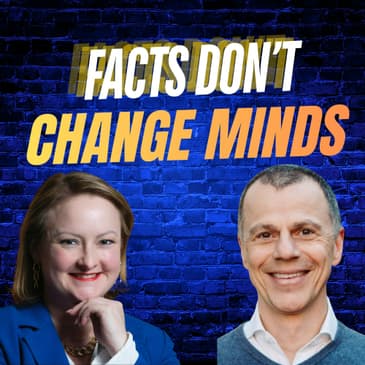
What if the reason people don't trust healthcare isn't the science- it's the communication? Rosa Hart sits down with Hamid Ghanadan, behavioral strategist, researcher, and author of Not Buying It, to explore why science and healthcare have a usability problem - and what communicators, clinicians, and companies can do about it.
From the neuroscience of decision-making to the Space Shuttle Challenger to vaccine hesitancy and children's mental health, Hamid and Rosa cover what it really takes to communicate in a way that moves people. Ethically, effectively, and humanly.
⏱ Episode Chapters
00:00 – Introduction & Guest Welcome 00:22 – Hamid's Background: From Bench to Behavioral Strategy 01:27 – Healthcare & Science Have a Usability Problem 02:26 – Market Research, Strategy & the Linus Group 03:00 – Patterns of Top Science Communicators 03:13 – The Role-Play Problem: Titles vs. Humans 04:09 – Priming: Why "I'm Just Looking" Is Never True 04:44 – Why Scientific Jargon Backfires at Conferences 05:22 – Emotions in Decision-Making: It's Biology, Not Strategy 05:29 – The Neuroscience: Logic Alone Cannot Drive Action 06:04 – The Frontal Cortex vs. the Amygdala 06:29 – Communication That Moves People to Act 06:52 – Storytelling: A Technology Co-Evolved With the Human Brain 07:13 – When Storytelling at a Conference Got a Doctor Shut Down 07:39 – Healthy Skepticism as a Clinician's Superpower 08:10 – Lead With Curiosity, Not Data 08:54 – The Right Communication Sequence: Curiosity → Facts 09:35 – Putting Data Too Early Spikes Skepticism 09:58 – Does Scientist-to-Scientist Selling Work? 11:20 – Facts Alone Never Close a Sale 11:46 – Persuasion vs. Manipulation: Drawing the Line 11:56 – How Social Media Algorithms Exploit Decision-Making 12:50 – Ethical Influence: The School Lunch Experiment 13:27 – When Good Communication Is a Public Service 14:14 – Space Shuttle Challenger: A Catastrophic Communication Failure 15:39 – Having the Right Data Is Not Enough 16:00 – Hamid's Personal Story: Not Understanding the Science He Studied 16:42 – Open Access Is Only the First Rung 17:45 – Stop Thinking About How to Teach; Think About How People Learn 18:39 – Start With Their Question, Not Yours 19:19 – Why Asking More Questions Predicts Better Outcomes 20:29 – Hamid's Two Questions for Rosa 21:34 – What Drives Rosa to Keep Podcasting 22:18 – Curiosity, Ideas & Grandparents' Theological Conversations 23:13 – Rosa's Week: Nurse Con at Sea & Family Before the Trip 24:55 – Online Highlight Reels Are Not Real Time 25:52 – Hamid: Posting for Content, Not Attention 26:00 – How Long It Took to Write the Book (A Hard Question to Answer) 26:47 – Building a Book from Years of Small Practiced Moments 27:41 – Selling Health Literacy to the Public 28:04 – Rosa's Book: Speak Up Start Now & the Nurse as Translator 29:10 – When a Patient Hears a Diagnosis: The Voice Fades Out 30:12 – Asking "What's On Your Mind Right Now?" in Clinical Settings 30:53 – A Doctor Who Relearned Storytelling 31:14 – Francis Collins on the NIH's Biggest Regret 32:28 – Transparency in Public Health Messaging 33:29 – The Billion-Dollar Question 33:45 – Mental Health: The Pandemic We Don't Treat Like One 34:35 – Family-Based Therapy & Back-to-Basics for Children 35:18 – Children Separated from Nature 36:01 – Psychedelics, Family Healing & What Comes First 36:26 – Phones Away: The Power of One-on-One Time 37:05 – A Mother's Meditation Changed Her Daughter's Life 37:54 – Not Buying It: The Book 38:22 – Find Hamid: LinkedIn & thelinusgroup.com 38:50 – Closing & Follow Nurse Rosa Speaks
📚 Resources Mentioned
Not Buying It: The Art of Selling to Scientists, Doctors, and Other Professional Skeptics — Hamid Ghanadan
Speak Up Start Now — Rosa Hart
The Linus Group: thelinusgroup.com
Connect with Hamid on LinkedIn
Follow Rosa: @NurseRosaSpeaks
🎙️ About the ShowNurse Rosa's Insights explores healthcare from every angle, interviewing the stakeholders, thinkers, and changemakers shaping the future of health. Subscribe wherever you listen, and leave a review if this episode made you think differently.
[00:00:01] I want to talk to my fellow nurses for a moment because this is important. I just finished reading Speak Up Start Now by Rosa Hart, RN, SCRN and I'm telling you for once someone said out loud what so many of us feel every day in health care that we're waiting to feel ready to feel confident enough to believe that our voices matter. This book shuts all of that down in the best possible way.
[00:00:26] Rosa doesn't just write from theory. She writes from lived experience at the bedside, in leadership and in rooms where real decisions are made. And she reminds us page after page that imposter syndrome doesn't get the final say. We do. Speak Up Start Now gives you the tools to step into your voice with the confidence health care desperately needs from us. I'm recommending this book to every nurse,
[00:00:53] every new grad, every leader and every person who's ever felt like their ideas weren't enough. Because the truth is, health care can't wait and neither can we. The change we want to see starts with our voice, your voice. Do yourself a favor, get this book, read it and then go speak up and start now. Speak Up Start Now by Rosa Hart, RN, SCRN, available now.
[00:01:32] Hello and welcome to the Nurse Rosa's INsights podcast. I'm your host, Rosa Hart. And today I am joined by Hamid Ganadan. Thank you so much for joining me today. Yeah, thanks for having me. It's fun. So you are entering this as a nice blend of a health care stakeholder. I like to say that I interview all health care stakeholders on this podcast, which could be any human person,
[00:01:59] because we all have a stake in health care. But yours is unique in that you came from the research bench. And now you do a lot of public speaking and you've even written a book about how to communicate persuasively and or sell to people who are more science related. And that is not something that I've seen a lot of researchers jump into. A lot of them do not want to volunteer to
[00:02:27] be communicators. So how did that happen? Yeah. Well, first of all, thank you for having me. You're right. I don't meet a lot of people like myself. And that is really where my career journey started. What I really care about is making sure that human connections get made. And especially in health care and in the sciences. I feel like if we are to make decisions about any aspect of life and health decisions are some of the most
[00:02:57] important decisions that are made, then I feel like health care has a usability problem. You know, science has a usability problem. And communications is one type of usability. There's other types of usability, obviously, but communications is another one. So flipping the script on figuring out how to teach things and instead thinking about how people learn things or understand things is really where
[00:03:24] my career started. And so, yeah, so it's taken many turns. What I do and what my team at Linus, what we do is we do market research. We develop strategies. And these strategies are all based on our understanding of this behavioral model of how people make decisions in technical or scientific or medical settings. And those are implications in marketing and sales and internal communications
[00:03:52] and employee communications, communications between sort of doctors and patients, even in fundraising and advocacy in a variety of other areas. Definitely. And you've worked with a lot of different companies now like Quist Bioscience, Tenet Economics, Thermo Fisher. I think you said Medtronic as well. Yeah. And are there patterns that you've seen the highest performing like science communicators do
[00:04:21] that others are not willing to try? I think one of the areas that we sometimes forget, everyone plays a part that they think that they need to be playing. So if I think that I need to be playing a part of a doctor, then I communicate differently than if I need to be playing the part of a dad. You know, I just, I put on a persona almost
[00:04:44] that may not necessarily be the way that I normally communicate, but context sets a lot of the tone and how people communicate. And so that's the first thing that I noticed that a lot of scientific companies think to themselves, we need to speak in a certain way. We need to have sort of science be the driver of the conversation and they forget that they're talking as humans to other humans.
[00:05:11] So that's, that's the number one pattern. You know, whether you see this in sales, right? And even you as a customer, let's, let's say you are, I don't know, shopping for something and you go into a store. I think people still go into stores for things. I do. Well, I do too. And, and a sales rep may come up to you and you may be looking for something very specific and a sales rep may come up to you and say, can I help you find something? And your immediate gut instinct is to say, no, thank you. I'm just looking, right? That's actually
[00:05:39] not true. You're not just looking, you're there to find something, but you are playing the role of the consumer who is supposed to fend off the salesperson. Right? And so those are the examples of, of these role plays. It's called priming. When we're primed to act a certain way, we almost certainly act that way. And so that's the, the first thing that we've noticed is that let's just deprogram these companies to speak more on a human level.
[00:06:06] Yeah, definitely. And it can be really frustrating when people who are trained in science to speak scientific jargon, like they're presenting at a conference that's really dry. I've heard some doctors talk about like, they'll get up and they would tell a story as part of their talk at a conference and get shut down when they were finished. Like just stick to the facts. We don't
[00:06:33] need all that emotional stuff. But what have you learned about you as a scientist also like making decisions? Are you always making them from a rational perspective or do emotions really play into your decision making? I think it's, I think what I'm about to say is, is a fact of biology that humans can't make a decision on logic or rational information alone. They cannot. So I read somewhere where there
[00:07:03] was a study where some people had, I think there's this type of nerve damage from trauma where the, their sort of thinking part of their brain was disconnected from their amygdala, which is the sort of the emotional part of the brain. And they become clinically, they become indecisive. They cannot make a decision about what to, what to wear that day, what to eat that day. They can't leave their house. It's, it's a terrible situation. So, so we as a species need those emotional triggers to get us
[00:07:33] to act. The, the, the frontal cortex can understand things, but it doesn't actually drive the body to act. It's that, it's the, it's the emotional center. And so that's another place where we get it wrong. If we're communicating, there's nothing wrong to communicate for understanding. Like I want to understand you. You want to understand me. That's a, that's a very formidable and, and great one type of
[00:07:58] communication that needs to happen. But a lot of communications, most communications happen for a purpose. And that purpose is to get some people to act, right? Because if, if you have an objective, if you have a goal, if you have whatever, it requires some group of people to act. And that's a different type of communication. And in order for people to act, they need, you need to understand their patterns. You need to understand their emotions, storytelling techniques, storytelling, storytelling is a
[00:08:26] technology. It's a technique. It's co-evolved with the human brain for millennia. It's actually the most effective way of getting people to act. So when these doctors that you were talking to receive that negative sort of feedback about telling a story, that's actually an audience, I think, emoting back to them that they, that they were not yet convinced they needed the data to convince them, but boy,
[00:08:54] were they emotionally drawn. That's actually what they're saying is that you hooked me, but I'm skeptical now and you didn't give me enough data. And now, you know, for whatever reason, I like, are you trying to manipulate me or not? That's, I think the backlash that they're getting. So there's a natural way in which like a doctor, a nurse, you know, there's a natural pattern for how they make decisions. And so the first thing that you need to do is get them out of their skepticism, because
[00:09:21] that's sort of the resting state for a scientist, for a doctor, for a nurse, for a clinician is just like, okay, information needs to be vetted in order for me to believe it. Right. And so. Not even from a negative perspective, but just like a trust, but verified perspective, like, okay, show me why. And, and you know what? I want all my doctors to do that. I want all my nurses to do that. You know, like, that's actually a good thing. That's their superpower. Right. Same thing with the scientists. If
[00:09:47] they just believe everything that they heard and saw, you know, it'd be a mess, but like, they're always skeptical all the time and they never believed anything that they heard or saw. We would still be on recovery 1.0, right? Like we would have, we would have never had a discovery yet. So what's the opposite side of skepticism? And that's where I started to explore this idea of, okay, scientists, doctors, engineers, technical professionals, there needs to be a level of
[00:10:13] curiosity. You need to start the conversation by making them curious, make them lean in a little bit. And that curiosity has to be emotionally charged a little bit. Like what's in it for me? Like this person's talking about something that may be relevant to me, not just like, oh yeah, this is what's happening in the, you know, in, in, in the industry or in the discipline or whatever. It's, this is, this may actually be interesting to me. So that, that leaning in that curiosity is the
[00:10:41] first step, get them out of skepticism, then naturally bring them back to satisfy their skepticism. So then you give them enough facts to form a hypothesis and then to validate that hypothesis with the, with the data and stuff like that. So that's the second thing that I see that a lot of these companies that, that you mentioned, sometimes they put the data too early in the conversation. And what that does is it creates that, it just spikes that skepticism right back up.
[00:11:09] Well, what about this data? Where did you get it? How did you do that experiment? Is it real? Is it, you know, like all that stuff. And it's just, it's not the right time yet in that natural decision making process. Yeah. So is it a good strategy when it comes to like communication styles for a scientist to be selling to a scientist because they speak the same language or can that backfire?
[00:11:35] I've, I've seen that be very successful and I've seen it be not successful at all. So I actually don't think, I don't think it's a prerequisite. It's, you can, if you were say a CEO of a company that's selling either scientific equipment or hospital equipment or, or medical devices, you could hire a sales rep or a sales team that speaks the language of medicine or science. And you don't, that way you don't have to teach them what's going on, but you still need to teach
[00:12:01] them sales. If they don't have a systematic, true, like artistry of sales or marketing, they're not going to succeed. They're just going to go in there and have a bunch of, you know, sort of medical conversations or technical conversations. And they're not necessarily moving the sale to success. And sometimes they even get the wrong, they understand the response incorrectly. They come out saying, I just had a really great clinical
[00:12:27] conversation with a doctor. They were hooked. They're definitely buying from me. And then the phone never rings again. And what happened was that you had, you like that, that doctor or that scientist was just sort of doing science or medicine for sport. They were just enjoying themselves. You hadn't really hooked them to want to change a behavior or take an action. And that's the piece that a lot of people miss. If they're trained in science, they just think, oh, the facts are just
[00:12:53] going to do the work for me. I've never one time, Rosa, seen a customer be sort of wrestled into submission with facts and data and be like, okay, take all my money. Right. This never happened. You have to get them hooked somehow. Which could sound manipulative, but at the same time, like persuasion is necessary for life. It's not necessarily a negative thing.
[00:13:17] I agree. Some techniques can be manipulative. I feel like, so, so we're, it's my opinion that we are manipulated every day in social media. The order with which if you scroll and, and there's a very specific sets of pieces of information that they send you. It's like, and this is not my work, it's somebody else's work. So I'm quoting someone else's work, but I've read that they're basically
[00:13:44] the best, the most successful algorithms will send you a signal of novelty, like something that'll just blow your mind. Then they'll send you a tribal signal. So like, you know, you see some sort of a crowd reacting to something. Then they send you a signal of whatever, and then they send you a fourth signal, and then it's an ad. And those, those four preceding things are meant to sort of hypnotize you into making a decision that I believe to be highly, highly manipulative.
[00:14:12] Yeah. It's a recipe, isn't it? Exactly. But let me ask you something. Let's say that you are in charge of a school lunch program at your, at your school district, and you want to provide healthy options for kids, and you don't want to manipulate them. You just want to provide them healthy options. Now, the order with which you put them, put the food choices in front of them, whether the salad bar is after they've gone through and picked up the chips and the, and the French fries,
[00:14:41] or if it's before, will make a substantial difference on how much sort of raw vegetables and fruit that the children eat. Have you manipulated them in that situation? You know, I actually believe that that that's an area where the children still have choice. Everyone still has choice, but all you're doing is making sure that they know that these healthy options are available before they commit to the unhealthy. Those kids can still bypass the apple and get the, get the,
[00:15:08] the French fries. And many do, but at least the apple has a fighting chance. You know, so that to me is not manipulation. Also, when you, when you are communicating effectively for a shared purpose, right, a shared beneficial, I feel like it's actually not only not manipulated,
[00:15:32] not manipulating, it's actually doing a service to the shared outcome. Like I'm going to learn how to, how to get this through. So example, I'm old enough to remember when the space shuttle Challenger met its fate. You know, I was actually, there was a, we had an assembly in school. I think I was in ninth or 10th grade and it was terrible to see this thing like go up in flames. I actually studied what happened the week before that at, with the scientists at JPL and with NASA,
[00:15:59] JPL was saying, do not launch, like abort launch, do not launch. And because that this, that this space shuttle Challenger was so highly publicized and the, the, you know, the folks at NASA are like, no, we need to launch. And they're like, do not launch. We have data that shows that, that the ground temperature is too low for you to launch this thing. And so they said, okay, you have one hour
[00:16:23] to convince us. And the scientists came in and they just botched the presentation. The way they showed the data was all messy and all over the place. And it didn't show this perfect graph between, between temperature and launch failure. They had the data, they had the data, they showed the data, they just didn't tell the right story. And here we are. Right. That's terrible. It's a terrible outcome that those JPL scientists, and they, I mean, there's one, one guy who resigned. He's like,
[00:16:52] I refuse to sign this. Like we should not launch this, this space shuttle. And, but you know, it was a failure in storytelling more than anything. Wow. That's really a good illustration of it is a matter of life and death, learning how to communicate. And you can have all the right information, but if you don't present it in a way your audience can receive it, then you might as well have said nothing.
[00:17:18] Yeah. Yeah, exactly. You know, the whole thing about me saying that I think that science has a usability problem and healthcare systems have a usability problem, that's a very personal thing for me. I studied science and I didn't understand it. And I was made to feel very inferior because, because this was supposed to be like, this was supposed to be my language. Right. I had studied it. I was practicing scientists and yet I would pick up science or nature or sell. These are
[00:17:46] all magazines where the highest sort of echelon of science is usually published. And I understood maybe 20% of what I was reading. And, and it's, and, and, you know, there's a whole movement around, well, if, if science is funded by the public, then public should have unfettered access. So it's called open access. This whole idea that like journals should not sort of copyright this, they shouldn't paywall this, this should be freely available. And I agree with that, but I also think
[00:18:13] that's the first rung of a really tall ladder because even if you put that stuff out, your words exactly, like if you can't communicate that well, you might go. Yeah. If I don't understand and I studied science. Nevermind what's allowed to get published. Yeah. That's yeah. That, that, that's a whole other, like, yeah, the entire publishing industry is really fascinating. You can have an entire other podcast about that, right? Yeah, exactly. Well, you could probably host a whole series about that one. Yeah. Right.
[00:18:41] But, but no, absolutely. So there's, there's a lot of sort of information as currency issues, but just at the most basic level, understanding your customer. Remember I said, maybe you should stop thinking how to teach and start thinking how people learn. Yeah. It is a very different thing, right? Because you have your objective that you want to teach because you as the health professional know that if you relay this information, it will equip people to have a better quality of life. Like
[00:19:10] maybe in my line of work, prevent stroke. That would be great. Yeah. But people are thinking in terms of their current pain points and they're not ready to necessarily listen to what my objective is. So like one thing that I found really helpful is start with their question and seek to answer their question and include the answer that I know needs to be in there,
[00:19:36] but I guess cushion it or sandwich it in there. Yeah. You know, you bring up questions are a fantastic tool for bringing people together. They're, they can be really powerful. We teach this a lot when we do sales, you know, when we, when we're teaching salespeople questions, just a sheer number of questions, forget what questions you're asking. Sheer number of questions are a positive indicator of
[00:20:01] positive outcome at the end, whether it's a negotiation, a sale of you're on a date and you want a second date, whatever it is. Then the more questions you ask, the higher your chances are that you'll, you'll succeed. Oh, you know what? I, I see it now. You need to partner with Scott Galloway. Teach men how to communicate. I know he's done a lot for, you know, advocating for the needs of men right
[00:20:25] now. And I will just say, can I share with you that as a podcaster, I love to ask questions. I get to know people. And most of the time we will leave an episode. I'm not going to presume it'll happen here, but I hope it does where you feel like I'm your new best friend. Yeah. But you weren't asking me any questions because that's your role in this case. But when I actually do have two
[00:20:52] questions for you that, that I had prepared and absolutely I did. So you baited me. Are you trying to be my new best friend? No, I, well, I hope that we do become best friends, but, but I did have two questions for you. Okay. And again, like you saying, going back to the very beginning of where we started our conversation, I'm playing the role of being your guests. You are playing the role of being my host. And so your role is to ask questions and my role is to answer them. I always find like
[00:21:19] you throw two questions out there or one or two questions out there and the entire conversation can change. Somebody else can light up whatever it is, you know, like it's so, so yes. Well, now I'm curious, what are your questions for me? My first question is what keeps you doing what you do, especially around this podcast? Like what is the force that's driving you to keep doing it? Because you're past the sort of the number of episodes where it's easy. You are well into like when it's gotten hard and
[00:21:48] you've overcome that. And so I'm just curious, like what's the, what's that, what's that energy that's underneath that for you? It is that, it is that compulsion to connect with people. Like I love connecting people, connecting with people in this way, because even if it's, even if a lot of the time I don't necessarily feel like it's reciprocal, if they don't know how to reciprocate that curious energy back at me, there's a degree that we're getting below the surface. You and I have not talked about the
[00:22:18] weather at all. We're not talking about politics or anything. We're talking about ideas and concepts. I love talking about concepts. When I was little, I would go to my grandparents' house and my grandparents would sit around talking about theological ideas with their friends. And I would just sit and listen, which a lot of people might have a hard time believing because I talk a lot,
[00:22:42] but I just love that curiosity and the exploring of the ideas for its own sake. And then maybe something good would come out of it and holding space for that. Because I feel like there's so much communication where like, if it is a sales conversation, you want something out of that, right? Or you're educating somebody, you want them to obtain that knowledge from it, right? It's
[00:23:06] checking a box or a sense of accomplishment. And I love that in podcasting, at least I have this agency where the conversation can be the end unto itself. And I love that. Yeah. Thank you for that. That's amazing. Well, thank you for asking. Absolutely. No, it's always really nice to get to know someone's like, I don't want to say someone's
[00:23:31] why, but, you know, just, just at least a little glimpse into the bigger picture here, you know? And so, well, thanks for being willing to share that. So. Yeah, definitely. Do you want to know the second question? Yes, I do. Okay. So you and I know each other inside of these two boxes, right? What is it like to be you this week? Like, like open the door to the rest of the week. It is Friday night and I did not wait for this week to be over. Right.
[00:23:59] I had a lot of things I needed to wrap up at work because next week I am going to take off for vacation and go on the nurse con at Sea Cruise with Nurse Blake. And so it was a crammed week where not just doing laundry and packing, like at work, making sure things were caught up and also try to plan ahead for the next week and then do cool interviews like this one. And I'm going to go to the next week. And I'm going to go to the next week. And I'm going to
[00:24:28] go out to lunch or dinner where I got a chance to and actually see my family a little bit before I leave them for a week. Nice. It's been a very full week. I think a lot of people, even those who watch me online in my various channels, I'm posting kind of on a delayed schedule. So they'll see me at work and they're like, I thought you were in Arizona at a conference or something. I'm like, no, that's a couple weeks
[00:24:55] ago. I'm just still posting content from that. And I've been back for two weeks. So you're right that it's not just that the internet is a highlight reel. It's just not necessarily in real time either. Exactly. Exactly. So thanks for sharing that as well. What's that? You ever have that happen where people don't know what to think about you and what you're doing, because they'll see you online one way and then they see you in person and it confuses them?
[00:25:24] Yeah, I have. Yes. So obviously, I'm having written a book and I speak from time to time and I'm lucky enough to get on podcasts from time to time. So it's really enjoyable for me to do this kind of work. I'll once in a while post a video of just myself talking, like mostly on LinkedIn or whatever. But yeah, a lot of times, but they're also asynchronous with where I am at the moment, you know, and so I'm not the type of person who takes my phone and does this at a conference and
[00:25:50] and then posted five minutes later. So it's, you know, I try I don't post just for like, and this is no disrespect to people who do this, but I'm not posting for attention. I'm posting for content like, like, you know, when I make a post, that is actually me practicing part of a talk I'm going to give or it's me practicing a part of my next book or my next paper or a report that I'm going to write or something like that. You see what I mean? And so so people ask, like, how long did it
[00:26:20] take you to write this book? I'm like, I can't really answer that question because when I opened the first like document to start it was maybe maybe from then it took about a year, but maybe five years because I was practicing pieces. I had little, you know, I tried something on an audience. They reacted a certain way. I built on it. So it's it's really hard to answer that question for me. And so that's what I'm actually doing when I'm posting. And so, yeah, sometimes it's totally
[00:26:47] asynchronous. Well, I love that intentionality. And that's a great way to repurpose your content to a lot of people will take like the long form content and clip it down into smaller things to repurpose it. But I love how you describe your building, your content from all these little pieces over time. Yeah. And, you know, I've seen a lot of doctors do that. Some nurses I've seen, I've followed a lot of nurses and a lot of administrators and health care organizations. And that's really what they do
[00:27:15] is that they're just, you know, it's not just for attention. It's for actually building a larger kind of discourse, you know. Yeah, it's we got to do that. And that's one thing that, you know, on the one hand, you were taught, you've talked a lot about, you know, how to, I guess, sell to scientists, for lack of a better term. No, that's fair. But, you know, it's like, how do we sell these health
[00:27:40] concepts to the public and level up the community health literacy? Like, yeah, that's something I'm really passionate about. Dr. Mike does a great job with it. You know, I'm trying to do that in the stroke area. And really, my book, Speak Up Start Now, is to encourage other nurses because we are experts at translating what doctors say to what patients can understand. If we can put that out
[00:28:07] in the way that we know how to communicate it, maybe other nurses in labor and delivery or ortho have insights on how to communicate certain ideas that are really not going to be proliferated because the doctors might get asked to do it. And then they might not have time. And if they do, they still need a translator, right? No disrespect, but... No, no, I totally agree with you. I think it's really critical. And, you know, thank you for writing
[00:28:37] that book because I think it is really, really important. But that interface between sort of the medical establishment and patients is an area that my whole team and I are incredibly passionate about. There's a lot of work on, like, what's the patient journey or what's the, you know, what's the health journey or whatever. And most of those seem to be really observational at the surface. Putting yourself in the shoes of a patient, forget the words that are being said at the time. Like, if I just get
[00:29:06] a really bad diagnosis and you're the clinician telling me this bad diagnosis, your voice is fading out, right? As you're talking, your voice is fading out. I'm starting to think, how am I going to tell my family this, right? I'm not at all tracking. I may be going like, uh-huh, uh-huh, uh-huh. But I'm not even hearing you, let alone understanding you, you know? So just focusing in on that and just maybe even a clinician be like, hey, what's on your mind right now? You know, and for me to be like,
[00:29:34] I don't even know where to start. Should I tell my family? Should I not? What's the right? And, you know, doctors, nurses, we're not trained in that. You're not trained in that. Like, you know, you're not a counselor, right? And yet you are with people in some of the most vulnerable moments in their lives and some of the most critical moments in their lives. And so that's an area that on a one-on-one perspective of, again, going back to really understanding patients as humans
[00:30:01] and also telling them stories. Like, you know, I heard a doctor talk about this once where he was talking about how, like, he gives the pamphlet at the time, like, delivers the diagnosis, gives the pamphlet, and then he's like, I wonder why I'm not more effective, right? And so then he went back and he basically relearned how to tell stories and relearned how to, like, and he became incredibly effective in doing that, you know? And so I'm really passionate about that on that level. And then on the
[00:30:29] more sort of general public level, on a societal level, that's huge for me as well. So, you know, areas around understanding behavioral science. So Francis Collins was, he was the head of the NIH and until recently, and he retired right after COVID, right? So, and on one of his interviews, I can't remember for 60 minutes or another one of these big shows, he was asked, is there anything
[00:30:55] that you wish you had done during your time as the head of the NIH? And he said, you know, we underestimated human behavior. I wish I had spent more time understanding human behavior because I never, ever thought that you would have 65 million people in a pandemic reject a vaccine that is shown above and beyond the efficacy and above and beyond its, you know, its sort of adverse side effects.
[00:31:21] And we should have understood this. We should have been better. And I was like, yeah, we should have. But we absolutely should have. You know, again, not to manipulate people. Not like there's a specialty in behavioral psych or anything like that, that they could have discussed it with. That's the thing is this information is there. Yeah. But again, we get into that role play mode. I'm the doctor. I'm the scientist. I have the data. Do as I say. I know better. Or here's the
[00:31:51] data. Read it on your own. Like then make up your own mind. Like those are the norms that have plagued us in how we communicate with each other and how we communicate with the public. And I am here to say we need to break that. You know, we should have put out cartoons. We should have put out, you know, like, like there could have been many, many ways in which we could have communicated this, this situation. And again, like, you know, you let, I'm a firm believer that you are,
[00:32:15] you like your body is your domain and you know, all that, like, like you should absolutely make that, that final choice. Having said that, do it for the right reasons, you know? Yep. So like that, that's the one. And in a not condescending way. Not at all. Not at all. Like not, don't go on national television and tell everybody we didn't give you all the information because we didn't think you could handle it. That's, yeah.
[00:32:42] Then expect people to trust you implicitly? No. Right. No, exactly. Or even say, oh, here's the information. And then it's like garbledy book, right? To, to, to the people. Like that, that's, that's the part that I have a hard time with. At least, at least make some effort on that part. Like, you know. At least it'll look like transparency. It's not like a redacted study, right? Yeah, exactly. Exactly. Yeah. That, that's so, so that again, like for me, it's very personal
[00:33:11] and reading science and not understanding it and wanting to, wanting to understand it. I'm really passionate about science, to be honest with you. And then I realized, okay, my, my home and my life is in hopefully helping bridge this chasm that's there between, you know, all these different people. And then the more I get into it, the more I fall in love with it because it's just all people. And I love people. I think it's wonderful, you know, that, that we are, I always say people are beautifully complex, right? And I think that's, and I love
[00:33:39] that beauty in the complexity. Me too. You can learn something every day just listening to people. So I guess this brings us to the billion dollar question. Are you ready for this? I'm ready for the billion dollar question. Okay. So Hamid, if you were given a grant for $1 billion to meet a need you see in healthcare, how would you like to see it used strategically
[00:34:04] to have the most sustainable impact? I would spend every last cent of it trying to understand and create better therapies for mental health, especially for the generation of children that are growing up right now. And I would, I would not stop at any place. I would, I would make this, in my opinion,
[00:34:27] this is a pandemic and we, we don't, we don't treat it like one because we don't break out into sweat and start coughing and you know, but it's contagious. Yeah, exactly. It's not contagious, but it actually kind of almost is contagious too. So all of those facets are there. And I just see so many families struggle because of this and that the resources are not there. The science is not there. The support
[00:34:56] is not there. The urgency is not there. And, and I feel like we need to do something about it and I would love to do something about it. So when you say the resources are not there, do you imagine a resource that if you could just plug and play and put it in, you, you pretty sure it would make a big difference? I think based on mental health is a really, really broad. It's really broad, but if you
[00:35:22] could narrow it down. Yeah. So when we're talking about children, I can, I can say that the family plays a huge role in, in the, the care and the, um, the recovery and the sort of the health journey. It's, it really is a family affair. Um, and it has, it has shown that family-based therapy is actually some of the most effective. And so I would put that, that's probably where I would start. I would
[00:35:52] also at the same time, make sure that we go back to the very fundamentals of what children need in different stages of growing up and make sure that they get that. And what I mean by that is like, are they getting fresh air? Are they getting sunshine? Are they putting their hands in dirt? You know, are they touching grass, touching grass? Exactly. Like all the things that you and I grew up doing because it was just the natural thing to do, uh, our, our generation of children are now just
[00:36:22] completely separated from. And so, you know, going back and, and, and really looking at all of the fundamentals and teaching families how to maybe make some very, very small changes, but also commit to that, to that. So that, that may be, that actually comes from my own personal like journey, but it's, it's an area that I feel like it does have a lot of promise right now. Um, you know, obviously there's,
[00:36:48] there's a lot of research being done on, on psychedelics and their outsized ability to really be effective for a lot of trauma. Absolutely. Yeah. So, but even, even before any sort of extra external substance enters the room, I think family-based therapy is incredibly powerful. I think there's a lot of simple things we can do. Like if you've seen me and my family out to dinner,
[00:37:14] there are some times where we are all on our phones and there are some time, and that may be after we have spent too much time together and we need a break. Thank you very much. Absolutely. But there are other times where, for example, if I know I'm going to be traveling, then I'll take my, one of my kids out to eat and we'll just be the two of us and we'll put both of our phones in my purse. And that way we
[00:37:39] have to be interacting the whole time. And it might not officially be therapy, but that human connection is such great preventative therapy. Like having that connection together prevents so much drama later, you know, and it's just simple decisions that can be uncomfortable. Maybe we would enjoy the dopamine of scrolling or whatever in the meantime, but we have to make- I love that you do that. I love
[00:38:08] that you do that as a, both as a family and on a one-on-one basis with your family members. I think even if the conversations are awkward or weird, they're still better. They're still so much more. They still do so much more good than, than we're aware of. And I'm just, you know, I, I really want this generation to grow up and be resilient and do amazing things. And so that's
[00:38:35] what I would do with a billion dollars. Well, I support that. And I think that we can take individual steps like that to help our kids, but we have to be intentional about it as parents and not wait for institutions or the government to tell us, you know, science has proven this 10 years from now when we stop gatekeeping the science. Right. But those are things that we know we can do
[00:39:00] right now that can make a big difference. I agree. And I just, you know, for anybody who's listening, who are watching this and you are a parent, like it's not easy. And there aren't any like manuals or tools or anything like that. There just aren't. I mean, there are, but they're not one size fits all. They're not one size fits all. And it really does require a lot of hard work. You know,
[00:39:25] I was talking to someone whose daughter had severe mental health issues. And at a certain point, she decided she was just like, I can't help her anymore. And she was trying really hard to do like the parent thing and help her. And she's just like, I'm just going to start working on myself. And so she started meditating and the daughter improved. Nothing else had happened. The mother started meditating and the daughter like turned her life around within months. Right. That,
[00:39:52] that is an incredibly powerful story. Like I got tears in my eyes when I heard that one. So, you know, it's, it is, it's, we are, we are a connected species, whether we like it or not. And so this is what I do for a living. This is what my company Linus does. And this is what I'm also passionate about personally. Yeah. And, and remind us, what's the name of your book that you're talking about right now? Sure. The book that I wrote is called Not Buying It,
[00:40:19] The Art of Selling to Scientists, Doctors, and Other Professional Skeptics. Excellent. I love that. And I'll have the link to that in the show notes. So if anyone wants to have you come speak or otherwise reach out to you, is LinkedIn the best way to find you? LinkedIn is a great way to find me. And then also you can reach out to us on our website, which is thelinusgroup.com. That's L-I-N-U-S, like this newbie character.
[00:40:44] Like this. Yeah, thelinusgroup.com. So be delighted to hear from your, your viewers and listeners. Yeah. Right. And so for our listeners or viewers, if you are enjoying this episode, make sure you like and follow wherever you're listening, or if you're watching on YouTube, please give me a comment. Let me know if you learned something or if there's something else that we need to talk about on the Nurse Rosa's INsights podcast. I am always looking for more
[00:41:13] healthcare stakeholders who have ideas on how we can build a better healthcare. And you can follow me on all the social media channels at NurseRosaSpeaks, and I will see you in the next episode.