
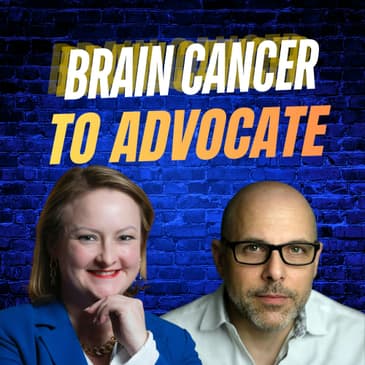
What happens when a piano prodigy gets diagnosed with brain cancer at 21 - and never shuts up about it?
Matthew Zachary, founder of Stupid Cancer and author of the new book "We the Patients" , joins Nurse Rosa to talk about his extraordinary journey from Staten Island music prodigy to one of America's most fearless healthcare advocates. We cover his diagnosis, 30 years of fighting for patients, and his bold new proposal: organizing America's sick and angry into a bipartisan voter bloc to take on the health insurance industry.
Links & Resources 📖 We the Patients by Matthew Zachary — bookstores nationwide, bookshop.org, Books-A-Million 🗳️ Take the American Patient Healthcare Poll → https://www.wethepatients.org/ (free, 5 min, anonymous) 🎬 Suck It Up Buttercup documentary (featuring Matthew Zachary, Mark Cuban, Wendell Potter) 🔍 Find Matthew: Google "Matthew Zachary" — or LinkedIn 📱 Follow Nurse Rosa: @NurseRosaSpeaks on LinkedIn, Instagram & TikTok 🎙️ Subscribe to Nurse Rosa's Insights wherever you listen or watch on YouTube Timestamps 0:28 – "I was drafted into healthcare" — cancer diagnosis at 21 1:49 – Growing up a piano prodigy on Staten Island 2:19 – 10 years of training: Broadway, jazz, classical, film scores 3:33 – Dreams of USC Film School and becoming the next John Williams 3:46 – The diagnosis: summer 1995, headaches and a numb left hand 4:29 – Symptoms worsen: slurred speech, double vision, misdiagnosis 5:13 – December 1995: MRI reveals a golf ball-sized tumor 5:29 – What is a medulloblastoma? A congenital brain tumor explained 5:59 – Why Matthew was one of the oldest patients ever seen with this tumor 6:27 – Did the brain tumor make him a piano prodigy? (The Simpsons comparison) 7:10 – Surgery: "It was killing me, so I'd rather have it out" 7:51 – Everything he accomplished musically before grad school 8:44 – Nurse Rosa's music degree detour 8:46 – How music helped him survive radiation — and why he brought a boombox 10:13 – "Russian gulag" radiation chambers: the silence, the beeps, up to 90 minutes 11:40 – The book: We the Patients — 30 years in the making 13:20 – Mr. Rogers and "What do we do with the mad that we feel?" 14:47 – Why fundraising and lobbying Congress no longer work 15:26 – The voter bloc concept: bipartisan, single-issue patient power 16:26 – What IS a voter bloc? The gun lobby & abortion as models 16:20 – The one thing every patient in America can agree on 17:29 – Ralph Nader, seat belts & the healthcare parallel: better and safer is cheaper 19:26 – What is the "seat belt" for cancer patients? 19:28 – Safer health insurance: the real goal 20:43 – The shocking statistic: 80% of appealed denials are overturned, but only 0.02% are ever appealed 21:12 – How insurance intentionally denies care and profits from delay 22:01 – Prior auth reform, oncology medical debt forgiveness & upskilling nurses 23:17 – Why you can't cash pay even if you have the money — and banning that 23:57 – The billion-dollar idea: a national consumer protection & fraud commission 25:00 – Why this is a state-level, not federal, strategy 26:24 – We the Patients: what's being built (and what's in stealth) 26:34 – It's about money, not stories: the $30B waste from delay-deny 27:58 – 3.4%: the number needed to change anything non-violently (ACT UP, breast cancer wars) 28:55 – 20 million cancer survivors of voting age — that's the start 29:35 – This is not Republican or Democrat. Cancer does not care. 30:03 – "Did you vote to have your health insurance quintuple?" — reaching red states 30:52 – The death spiral: when healthy people drop coverage 32:05 – How to get involved & buy We the Patients 32:31 – Take the first-ever American Patient Healthcare Poll (free, anonymous, 5 minutes) 32:59 – Luigi Mangione, Brian Thompson & the awakening of the sleeping giant 36:07 – Suck It Up Buttercup documentary ft. Mark Cuban & Wendell Potter 37:00 – Time to stop "dial-up advocacy" and organize as a voter bloc 38:06 – Nurse Rosa on teaching stroke prevention: actionable hope 41:07 – Matthew's mic drop: "I'm a stroke survivor too" 41:30 – Radiation vasculopathy explained: the long-term effects of treatment 42:24 – 2011: waking up slurring speech again — and the terror of thinking it was back 43:14 – Stupid Cancer's "Try to Not Get Cancer" campaign 43:36 – Don't beat yourself up: the nurse practitioner who taught quitting smoking with compassion Nurse Rosa's INsights is a nurse-led healthcare leadership and innovation podcast hosted by Rosa Hart, RN. We explore nursing leadership, healthcare policy, primary care challenges, AI in healthcare, clinical practice transformation, and bold solutions from clinicians, founders, and thought leaders. Listen on YouTube, Spotify, Apple Podcasts & all major platforms.
[00:00:11] Hello and welcome to the Nurse Rosa's INsights. Joining me today is Matthew Zachary, kind of a legend in podcasting. So I'm super honored to have you here today, but thank you for joining me. Matthew Zachary Thank you for having me. I appreciate being here.
[00:00:29] Yeah, so we've been running in a similar advocacy space and wanting to make healthcare better for everyone. So Mutual Friend introduced us and I'm so glad.
[00:00:42] For those who don't know Matthew Zachary, he is a brain cancer survivor turned advocate who has been leading a movement. And so that's really what we're going to spend a lot of time talking about. So Matt, would you share with us from the beginning how you got into healthcare, I guess, from the patient perspective?
[00:01:09] Matthew Zachary I think everyone's often drafted into healthcare. It's not a demand market. I didn't go to cancer college to get sick and know what to do. You know, if you go into medicine, obviously you're a hypocrite used to guide your career path. But most people like me, you know, we get born of our condition and that condition can be disaffected or affected by kind of, you know, shit we didn't ask for. Matthew Zachary Yeah.
[00:01:37] Matthew Zachary So I was drafted into healthcare with a cancer diagnosis 30 years ago as a college student. And I haven't really shut up ever since because I'm still above the grass. And that was how I got into this. Matthew Zachary Yes. I'm so thankful. So now you were also, at what point did you learn how to play the piano? Because I saw that I missed out on an amazing concert the other night.
[00:02:02] Matthew Zachary Yeah, I was a prodigy that I didn't know I was a prodigy. My mom played as a kid. And my dad had bought her piano when I was in sixth grade because she hadn't played a while. And I came home from school. And I kind of knew already how to play trumpet because they forced you to play an instrument in the city. So I had an inkling of a clue of like what whatever treble clef was. And I saw her playing. And I was like, where do you put your fingers? And she said, blah, blah, blah.
[00:02:29] And I went, oh, blah, blah, blah. And she like did a double take and said, you're getting lessons. So like an hour later, I had lessons. And I was, well, pretty much. Yeah. She knew someone who knew someone that knew the like the most hoity, toity, Juilliard trained, you know, luminary concert pianist from like orchestras who taught kids how to play on Staten Island where I was raised.
[00:02:54] So Bertha Mandel, Bertha Mandel. And I was trained for 10 years, 10 straight years weaving in and out of genres and skills and learning Broadway jazz, classical, ephemeral world, global ethnomusicology. Went to undergraduate for music, learned musical theater, learned orchestration, learned like deep music theory.
[00:03:18] And I started composing for, you know, orchestras and film scores and TV commercials and all sorts of stuff on campus. And I just, I mean, who really knows what they want to be when they're 19? I kind of did. So that was it. That was when I started to, you know, want to go to grad school and study at USC film school and, you know, spend my whole life trying to even come close to being John Williams.
[00:03:45] Yeah. Well, I think Matthew Zachary is a good person to be. Now, when did you get your diagnosis? You said it was before you were able to go to grad school. Yeah. Yeah. So in the summer of 1995, again, like we're going back the way back in machine before AOL and floppy disks and all that crap. AOL back to layers. Yes. So, my God, how many, like Clinton's first term, pretty much just to throw back how far back this really was.
[00:04:13] Because I was, I'd taken off the summer, obviously, for school and I was interning at a company and I started to get headaches and I didn't know what it was. And I just thought, whatever. And, you know, you're 21, who cares? But then I got back to school in the fall of 95 and I noticed when I got back on the piano, I couldn't play as well. My left hand felt a little numb.
[00:04:38] And having played for 10 years, I knew my body. I knew how things worked. And I just immediately knew something was wrong. But again, 21, invisible, whatever, cope with it. I just practiced harder. And then, you know, and then the real stuff started to happen. The symptoms started. The headaches got worse. I started slurring my speech and having double vision and all this crazy stuff.
[00:05:00] And finally, after being misdiagnosed, which I forgive, no one really associates, a pianist that can't play with terminal brain cancer. So eventually I was taken seriously when things got really bad. And in December of 95, went for MRI and they found this golf ball in my brain that's been there my whole life. Wow. But it was just then starting to cause problems.
[00:05:27] It, for some reason, I learned many years later that the particular tumor I had is called the medulloblastoma. And it is one of the only congenital brain tumors. It develops in utero before birth and it lives inside your head and does all these creepy things. But most of the time, it genuinely, generally presents itself by the age of eight, mostly in boys.
[00:05:55] So you had a lot of bonus time there. I don't know how, I don't know what, but I was one of the oldest patients that ever seen at the time with this particular tumor. So it kind of threw them for a loop because they didn't fit into the standard, you know, kid cancer protocols. Yeah. The differential was confounded. Yep. Yep. It still confounds people now that, that even work in neurology and neurosurgery. Like you had what?
[00:06:26] When? Do you think it made you a prodigy at the piano? It advanced my educational capacity. Like it was like a little, like a turbo boost chip in my brain the whole time. Like put some extra pressure on the smart genes there. That reminds me of the episode of the Simpsons where they found a crayon in Homer's brain and they took it out and he got smarter. So like imagine after my surgery, I got dumber because they took it out. Well, I mean, you would always be afraid of that, right?
[00:06:54] Like what if you take out something I need in there? But so I'm sure that was a scary experience for you. It was scary, but it was killing me. So I'd rather have it out of me. Yes. You need that. Yeah. It was like a risk versus benefit. You definitely need it out for sure. Yeah. But yes, this all happened before I was supposed to go to grad school. So all those plans got shot to shit. But it sounds like you were doing plenty without grad school.
[00:07:21] Like sounds like you did more before being old enough for grad school than a lot of musicians ever get to do. Yeah. I really exploited my teens and 20s, early 20s with everything running the game from orchestra, jazz band, you know, TV and film, college, you know. So like college compositions.
[00:07:42] I was the pianist for the theater groups and the on-site campus theater groups, rehearsal pianist for the theater company and the opera company. I performed for the modern dance companies as an instrumentalist. I built and I played off-site and I played at bars and I did everything that I possibly could. And when you want to throw yourself into something you care about, it wasn't a dying minute that I wasn't doing something musical in college. It's beautiful.
[00:08:11] I got a bachelor's in music, but I switched to nursing like at the last minute. So, well, not... Presumably to make a living. That is true. I didn't want to be a starving artist because while people said I was a good singer, I was more of a classical style, which was not perceived to be a big moneymaker. So, yes, I did switch to nursing because I was like, well, that sounds like a steadier job type situation.
[00:08:40] But did you find that music was helpful for you in your recovery after your surgery? Well, funny you say that because I wrote in my book an anecdote. So in perspective, in the 1990s, you were just a piece of meat.
[00:08:59] There was no real such thing as cancer survivorship or quality of life or psychosocial well-being or mental health or community support or peer-to-peer. Everything we kind of rightfully take for granted today, should you have access to those opportunities, were bereft. And again, I can't blame the 90s for not having them. So I don't hold it accountable that I wished it was something I had.
[00:09:26] But I was thrown into like the bank vault of radiation chambers, which they had, you know, Russian gulag style bank vault radiation chambers back then. They've evolved quite a bit in the last 30 years. And it was so damn silent in there. And you just heard this whirring and these beeps. So I had asked them, can I play some music?
[00:09:55] Can I listen to some music while I'm getting, you know, zapped with whatever the hell, you know, plutonium? And they said no. So the next day... Did they think the sound waves were going to disrupt the radioactive waves? Like what? So the next day I showed up with a boombox and I said, I'm going to be playing music today in the bank vault. And they said, all right. So for the remainder of my radiation treatments, I listened to music during my zapping.
[00:10:25] Well, my goodness. So they just said no, like they couldn't provide it to you. No, they just said like, no one does that. We don't do that. Well, now they do it a lot in like MRIs and stuff like that. Did you start that trend too? Yeah, I'm happy to be the trendsetter. They got music into the bank vault radiation chambers and MRI, you know, patient experience. Do it, man.
[00:10:49] Well, thank you for that gift to humanity and softening up the experience a little bit. I can't imagine. How long were those radiation treatments? I know MRIs can take a while. Oh, God. I don't remember. 90 minutes? Are you serious? Some of them were that long. Because I had a whole series of cranniness spinal and intra something and with the stereotactic. And it was insane. It was just, yeah. I mean, don't hold me accountable to that.
[00:11:18] My dad would remember that more than I do. And for all, you know how when you're four years old, people look really old, but they're like 19. Like I'm probably imagining it being longer than it was because it was the worst hell on earth. Yeah. It felt so miserable. Yeah. Well, and that makes total sense. It's time is just a construct. So it is whatever you said it was. It's fine. So, let's see.
[00:11:41] At this point, do you want to go ahead and tell us a little bit about your book and how you come to be writing that 30 years later? Yeah. I mean, so I've had a very, almost like a terrible privileged life. I've always happened to be in certain places that wound up being beneficial to me and other people.
[00:12:04] I've always happened to be bumping into individuals along the way that became mentors, luminary people that have been lost to history that I try to give homage to and upon whose shoulders that I stand. And I never thought to write a book because who gives a shit about my story? There are so many books and memoirs out there.
[00:12:27] I really wanted to do something at some point that galvanized millions of people, not because I beat cancer. That was not something I planned for, not something I hang my hat on, not something I'm necessarily wanting to be. Congratulations. You're not dead. Dead. Although still congratulations. Yes. I'm thrilled to be not dead.
[00:12:51] I guarantee you, I will accept the accolades of being not dead, happily being not dead. But do we need another cancer survivor story full of anecdotes, right? Although I do think you gave your story as a keynote quite a few times. Well, yeah. And honestly, that's always done with the context of the intention of why I'm there. And in many cases, it's not, oh, my God, I'm alive.
[00:13:19] It's like, this is how much better it is today, even though it sucks. It's different terrible than it was 30 years ago. It's different, better and different terrible. And I really felt that if I'm going to tell not my story, but a story, what really needs to be packed in to a book all these years later?
[00:13:44] That, yes, it might be a summary executive of all the insanity that I've been through, but not really a memoir. But what I talk about in chapter one is what I've been talking about when I started, you know, Stupid Cancer and had a podcast in 2007, is what do we do with the shit we're angry about? And I base that on a Mr. Rogers quote that's in the book where he's sitting around with a bunch of children and he asks them, what do we do with the mad that we feel?
[00:14:14] And that was what I felt has been sort of my hill to climb for all these years is I can organize millions of people. I can galvanize through populist branding. I can do all these amazing things that I'm proud of with a bunch of people at my side, huge communities of wing people and colleagues and cohorts.
[00:14:33] But up until now, what do we do with the mad that we feel is, oh, we raise money for research and we fund for a cure or we do X, Y and Z or we beg Congress to do the right thing. And we hope the moral shit happens. And we reach the point now where that doesn't work anymore. It doesn't work anymore. It's all about money now. It used to be about power, but now it's about money. So what do we do with the mad that we feel is very different now?
[00:15:00] And the story I wanted to tell was what happens when, now that we stop raising money for research and supporting nonprofits, because we still need sort of like that downstream help. It's not going away anytime soon. People are still broke and in pain and need support and trauma. That's critical when you jump into the club that no one wants to be a part of that. There's some stuff for you to make it, as you say, less terrible.
[00:15:26] But my overall theme now after 30 years and all the little nuances in between that are just incalculably ridiculous that they happened in the first place is I'm proposing the country start to organize its anger as a voter block, not a PAC or a lobby group, a voter block. It's never happened in American history. Voter blocks are single issue bipartisan. So like the gun lobby is like you could be gay or straight or blue or black or whatever. They just care that you're pro too. Right.
[00:15:54] And then they, you know, made it terrible every other which direction possible. But they started with this being a single issue. Single issue is also like like abortion is a single issue. They don't care if you're Republican or Democrat. If you are pro choice, then you are single issue. So the question then I was asking with my colleagues over the years is like, what is the one thing every patient in America would agree on? Not dying is not one of them because we all don't want to die. Right.
[00:16:24] You got to just take that off the table. You can really legislate. You can't legislate, die, not die. No. And it really started out as no one should go broke when they get sick. Not universal health care narrative, not Bernie Sanders stuff. But what would it mean if we just didn't lose everything? And then that moved to can we not be swindled? Right. That would be really nice. And then the one above that was health insurance should not be our doctors. Right. See? For sure.
[00:16:53] That nodding of your head, that became what this book wanted to organize people around the idea. What does it mean when health insurance stops playing doctor and you get what you need because your doctor is your doctor and their job is to be your doctor and tell you no. So that is what my theory is in the book. That is what I want readers to take away.
[00:17:20] That is what I'm speaking about these days is the man that we feel now has to be channeled into legislative organized action. Definitely. And it's well past the point where I would normally ask my billion dollar question, which I am sensing is going to be aligned with where we are in our conversation.
[00:17:42] So, Matthew, if you were given a grant for one billion dollars to meet a need you see in health care, how would you like to see it used strategically to have the most sustainable impact? So when you had asked me this question for the show, I kind of already had my answer. And you actually gave me pause to write like a 2,000 word op-ed about it as well to put it out there. Well, thank you for not filling out the sheet with the 2,000 words.
[00:18:10] I think you condensed it to 200 for me. I did. I did. I came up with like a meta tag for it. But it's extraordinarily complicated what would have to happen with a billion dollars. But the gist of it, again, all this is covered in my book and my talks and my blogs and my content, is that it's all based on Ralph Nader in the 1960s. Oh, really?
[00:18:33] And what Ralph Nader did in the 1960s was prove to the auto industry, to the government, and to the automotive insurance industry that everyone will make a whole lot more money when we don't die on the highways. Agreed. So seatbelts and safety and infrastructure became the investment to save money.
[00:18:58] And all of a sudden, better and safer was cheaper. So you can make more money by doing less harm. And that then funneled into the Secretary of the Interior and Transportation on safety, bridges, tunnels, safe schools, you know, safe roads. So where I'm going with this is what is the seatbelt for cancer patients for anyone? Yeah, I'm in the cancer space.
[00:19:27] If you're focusing on this for a voter block of all people who can experience health care, then it's not just people experiencing a cancer journey. No, no, no. It might be stroke or it might be anything else, right? Yeah, yeah. I mean, we're technically starting in oncology because that's where the most harm and the most death and the most bankruptcy happens. And from there, we can trickle out to other things as tort reform and precedence.
[00:19:52] But with that being said, the fundamental concept is what is a seatbelt for a cancer patient? And in this particular case, it's not better health care. It's not access to health care. It's not health care reform or innovation. It's safer health insurance. And what does safer health insurance means?
[00:20:16] It means that they're going to deny you on purpose so you get worse so they can eventually cover you and then you die. What if you prevent that from happening in the first place? The just suppose you don't ban prior auth, but you set limits to protect your voters in that state with cancer from being harmed by delay. Yes. Yes.
[00:20:44] And then because the data always raises eyebrows in oncology, this might be a larger scale, but 80% of denials that are appealed are overturned. 80%. Yeah. For sure. But what percentage of denials are appealed? 0.02%. Almost none. None.
[00:21:12] And typically the people that are part of the 80% are the health systems and the patient navigators and the system course correcting for denials that were not intentionally, I'm sorry, for denials that were intentionally denied. Yes.
[00:21:32] So the insurance system counts on only 0.02% of people finding denials because if more than 0.02%, if 1%, it would ruin everything for them. So they intentionally deny care so they can bank their money and benefit from the downstream costs of delaying that care. Protecting a seat belt would mean a couple of things.
[00:22:00] And again, going back to that single issue that everyone would agree on because most of us have been screwed by health care and health insurance in some way, shape, or form is what if we never had to deal with a delay making us worse? What if the doctor in the insurance company is basically told shut the fuck up? What if you can forgive oncology medical debt forgiveness for families that it would ruin?
[00:22:27] If $10,000 of debt ruins a family in North Carolina, that's a minuscule amount of money to forgive to keep that family voting and working and paying their taxes. Is there any kind of cancer treatment that is $10,000 or less? It's about the debt. I mean, sometimes insurance covers it. Sometimes hospitals send you bills.
[00:22:53] It's all about protecting that constituent from the harm of not being a productive member of the state. And there are other mechanisms in seat belt terms like mandating that nurses and social workers and oncology get upskilled to navigation based reimbursements.
[00:23:15] That's jargon for you are now a covered asset and a billing code to exist in the hospitals to help them get less screwed from prior authorization. Isn't that wild? It is wild. It's totally wild. And then also like transparency over if you want to cash pay, but you have insurance, they won't let you cash pay. Right. So banning that. To avoid the delay, even if you have money. Yes, exactly.
[00:23:44] So there are so many things that fall under the umbrella of the seat belt metaphor that every American, minus the people that don't give a shit about us, plenty of those people, want in our states. So this is all about consumer protection.
[00:24:04] So with a billion dollars, I would create the country's largest consumer protection and fraud commission that operates at the state level to organize millions of voters not to vote, but to share the fact that they do not want to be harmed by the system. And to Ralph Nader's point, better and safer is cheaper and doesn't waste money.
[00:24:32] Well, you said not to vote, though. So but the point is to vote, isn't it? Well, if you're a PAC or a voter block, if you're a PAC or a lobby group, yes, voter blocks have civic power. So that's an influence you don't need to have with a prop or a down ballot or a mid-year election. It's what the states feel are best for their voters.
[00:25:00] And it also lives in a completely separate bucket from the insurance lobby's interests in buying our senators and our House members in the states. It's in the interest of the states to not have five billion dollars in waste from delay deny tactics, then get paid to get reelected by insurance companies because the voters will know. So that is the concept here.
[00:25:26] And should we ever need to do electioneering and primarying? That's when we work with PACs and lobby groups. We the patients does not need to do that. There are plenty of people who can organize those movements en masse.
[00:25:44] We are a populist group of angry citizens that are sick and tired of being abused by the absolute malfeasance and guttural, disgusting nature of what the health insurance company lobby has become. So practically speaking, if this group is created and mobilized, which you've already been doing, it is there. It is happening. Are there going to be like conversations with lawmakers?
[00:26:13] Are you going to be working with them to write bills that you'll be like tracking as a group and taking patients in to share stories of this is my real world experience and why this matters? There's no concrete answer to that right now. Would that be part of your aspiration or is that not the path that you want to take? See, if you ask my co-founders, we'll have different answers to that.
[00:26:38] My answer, my answer, and there's a lot of us in the We the Patients, you know, business right now, stewing a bunch of stuff and stuff. Okay. My take is always a hot take, which is they're not going to give a shit about our stories. It's about money now. There's $30 billion a year wasted and delay. And all that money goes to PBMs, all of it.
[00:26:58] And then $10 billion is the money that it costs a state divided by population, obviously, by having that intentional delay. And I mentioned of those 80% that are repealed or overturned, but it takes $20 billion for that 80% to be overturned. So you're looking at $30 billion of immediate waste from the delay-deny engines existing.
[00:27:26] So it's in a state's interest to not have that waste come out of its budget, to restore that money back to Medicaid in the states, to Medicare non-advantaged, regular Medicare in the states. Health systems, physicians, and employers want that money back. It's in the state's interest that health economic benefit to being in North Carolina or Iowa than it is to get their voters to give a shit about their stories. That's my hot take on this. Sure.
[00:27:56] So then- Whether or not we need a lobbyist, a legislator, a senator to give a shit right now, that's probably just gravy. There's nothing they can do until we are a 20 million strong civic power voter. 20 million across the country? Oh, it'll be everyone. But we start with specific data points in oncology. There's a great book I'm reading now, and of course I forgot the name of it. But it's about how they overthrew Slobodan Minosevic in Serbia in the 1990s through nonviolence learning from Gandhi.
[00:28:25] And there's a stat in there with something like 3.4%. You need 3.4% of any population to overthrow anything. Not violently, right? Wow. This is how ACT UP got AIDS working. More than 3.5% of America gave shit about this. This is how the breast cancer wars got like Herceptin introduced in the 1990s. This is how more than 3.4%.
[00:28:52] The cancer community alone, just the survivors over 18 of voting age, that's 20 million. That's way more than 3.4% of the country. You factor in caregivers and loved ones and family members, and you're looking at two-thirds of the country have been screwed by health insurance vis-a-vis some connection to what's happening. No oncology. For sure. Yeah.
[00:29:21] So, and it's not a Republican or Democrat or Trump or Biden. It's none of that. It doesn't matter who's sitting in the White House. This is a state-based benefit to voting. Cancer does not care. Money does not care. No. No. And honestly, again, I go out on a limb a little bit when I talk in red states or red communities, because no one knows what I do politically. I'm kind of in the middle.
[00:29:51] But I get a lot of like, you know, fine, you picked your voter. You chose your president. That's fantastic. But did you ever expect to vote to have your health insurance quintuple this year? No. We didn't vote for that at all. Right? You know, they could say what they want. Oh, he knows what he's doing. No, no, no. It's not about that. Are you okay going broke more than ever?
[00:30:18] Because it's going to cost you a Honda Civic worth of money to keep your family insured this year. And the answer's done. That's why a lot of people are going to choose to just go without insurance. And that's the death spiral. Yeah. The death spiral is when more healthy people go just go wing it. You know, go commando. So it hurts everyone. Good description. Yeah. That's definitely what it is. It hurts everyone else. Yeah. It's true. We didn't want to see that.
[00:30:48] No one voted for that. I guarantee you. You go to the red estates or the, you know, the lowest socioeconomic communities that maybe barely have something. They didn't vote to be told you can't have this. Yeah, for sure. Well, I really do appreciate your advocacy in leading this. So how can people get involved? And obviously they can go buy your book on Amazon or on your website, right? Yeah.
[00:31:18] It's whatever books are sold. This is in bookstores. It's on. I'm a big fan of like the independent online bookshops like bookshop.com. I mean, depending on where you are on the sliding scale of corporate America and billionaires not paying taxes, you know, you may want to consider buying it from like a bookshop or a booksy million online. Or just go to your local bookstore and say, hey, do you carry this? And have them, you know, old school, old school. Do you carry this? Can you order this for me? And the title is We the Patients.
[00:31:47] But it's not just a book. If somebody wants to be a part of this movement and stay in touch with you, I know I signed up. Where would you like them to go? The most important thing anyone can do right now with the mad that they feel, whether you read the book or not, is to take the first ever American patient health care poll. It is our political poll or bipartisan political poll.
[00:32:14] And we need about 10,000 people to tell us what we need to hear. It's anonymous. It's based on zip code. And we are collecting first ever data on how we really feel about the way health care disabuses us, takes advantage of us and confuses us with intention. That is the one thing. It's free. It takes five minutes. It's anonymous. We the Patients.
[00:32:44] It is really quick. Yeah. And very clear. And it's amazing what a difference a little data can do when you do put a good story to it. Like, look, you can use this and save a whole lot of money. What's been fascinating and not surprising, of course, because I've been working in this space for 25 years. And I'm not going to this is not a pro murder in any way, shape or form.
[00:33:08] But when Luigi killed Brian Thompson, the outpouring of hatred for health insurance. There's a great quote from World War Two where after we after Japan bombed Pearl Harbor and they realized, like, what have we done? I think it was Tojo said, we have awakened the sleeping giant because we were so quiet and passive. FDR kept us like hushed during all of the European bullshit. And we'll never forgive him for that.
[00:33:36] But I feel like the murder of Brian Thompson awakened the sleeping giant and very similar to the just the endless outpouring of how much people were thrilled he's dead, which is terrible. And now becoming, you know, Club Luigi to get him off the hook. It's a sign that we're just in pain. But no one's ever been given permission to voice that and do something with their mad.
[00:34:04] And having seen this book go out on Amazon and all the places, it's the same thing. Everyone is now given permission to just express how angry they are and how we're all getting screwed, blued and tattooed. And propose a solution that's not just cut off the head of the snake so that it can grow a new one and keep doing what it was doing because the money's still flowing.
[00:34:28] But how do we change the flow of the money so that it's not bankrupting the country and the individuals? Yeah, I mean, I'll give a short plug for a documentary film that I'm in right now called Suck It Up, Buttercup.
[00:34:42] And I'm in it with Mark Cuban and Will Flannery and Wendell Potter and just this extraordinary gaggle of physicians who either tried to kill themselves, lost friends to kill themselves, moral injury, medical suicide. And it's a scathing, scathing piece, expose on how health insurance is crushing medicine, how private equity is killing rural America, rural health.
[00:35:10] And they're just as pissed as patients are. Yeah. So we are all in this together to determine what what it means when we stop doing dial up advocacy and hoping Congress does the right thing and testifying before this and meeting with staffers. You know, there's a place for that, but it's not the thing we should be focused on anymore.
[00:35:37] It is time to finally organize as a bipartisan populist voter bloc and put all of our civic power together in one teapot to show our elected officials that your days are numbered unless you start protecting us from the harm of this disabuse. Definitely. It's just completely unsustainable.
[00:36:01] And you're absolutely right. And the thing is, I think people need actionable items to do in order to have hope. So one thing that I get to do in my day job is teach risk factor modifications for stroke prevention. There are a lot of things that you can't change, like your genetics, just like you were apparently born with your brain tumor. You couldn't help that. But there are things that we can do.
[00:36:29] And a lot of the times after, for example, someone has a stroke, they have a lot more anxiety because it's appropriate. Because something scary just happened and it might happen again. But sitting there worrying about it is not going to prevent another stroke. It's just going to actually increase your likelihood because stress is an independent risk factor.
[00:36:52] So what I teach them is to focus on the modifications we can make. What can you do? Focus on those tasks. And that helps control that anxiety and dispel that because you can have hope that at least I'm doing all of the right things.
[00:37:11] So, Matt, I really want to thank you for creating tangible actions that people can take to peacefully move towards a better future for how we afford health care. You know, I'm a stroke survivor, too. You didn't tell me that when we had our preview call. That's my drop, my mic drop for you here. You stinker. Oh, my. You did this on purpose. I'm just making it look good.
[00:37:40] That's what this is all about. You are making it look good. Any asymmetry you could have said, oh, that was the brain tumor and the surgery and all. Yeah, and I have something called radiation vasculopathy. It's a jargony medical term that you know, but for the watchers, the viewers, the listeners, it means that the capillaries in your brainstem. I mean, this is very big in like leukemia lymphoma in like your neck area.
[00:38:05] But for brain cancer in the brainstem, those capillaries after all this radiation became very frail. And they can pop and they can snap and crackle and all the things can happen to them. Cereal things. You mean like the cereal you eat. Yeah, right. Yeah. So about, God, it was 2011. So it was a while. It was like 14 years after all my treatments were over.
[00:38:33] I had reached an ungodly weight. I don't blame myself. It's hard to know why. But one day I woke up and I was slurring my speech again out of nowhere. And I lost my shit. I'm a pacifist in terms of there are no problems until there are problems. Versus like people like if there's no problem, that's the problem. So I woke up terrified, told my wife, told my kids, went through all this battery of crap. And it turns out I thought I had a tumor again.
[00:39:03] Right. Because that was your experience. Yeah, yeah. Like I slurred my, what the hell? I had a minor ischemic incident in the ponds that they attributed directly to radiation vasculopathy. So immediately I was put on aspirin and went to the stroke center. And I, knock wood, I mean, I'm not taking time bomb to begin with. But to your point, I don't stress about it.
[00:39:26] I do what I can to try and not get one again, despite having limited control over things. And just to wrap that up on the bum, we had a really stupid cancer was just so irreverent when I found it in the 2010s. We had a whole game angle try to not get cancer. And it was all about what can you actually pragmatically try to do? Because it wasn't like risk reduction.
[00:39:51] Because when you're, you know, when you're kid, you can't reduce your risk of leukemia as a kid. You can't reduce brain cancer in your teen years. There's just no like, you know, stick your head in a truck and get your like taco truck MRIs in high school. They don't do these things. So to your point, prevention really is just try, try to not the best you can. And don't beat yourself up about it if it happens anyway. Yeah.
[00:40:20] Like if I, even if I'm encouraging somebody to quit smoking, one of the nurse practitioners that I worked with in the hospital, I heard her teach a patient about this. And it was just so lovely. I had to copy it forever after. Because a lot of doctors would like, especially a neurosurgeon or a cardiologist who just pulled a clot out of somebody. They'll be like, you better not ever smoke again. Or this was a total waste of my time. Right. Did hear that said before.
[00:40:50] But I heard her go in and speak with a patient who had always been smoking as long as they could remember. Right, right. It's really encouraged them to cut back. And if it's cutting back one cigarette a day, as long as it takes to get down to zero, that counts. Every little bit does count towards letting your body heal and letting your blood vessels get better.
[00:41:16] And so it really is important that we demystify it. So it's not like you have to do everything right cold turkey. Correct. It is a process to make lifestyle changes. Mm-hmm. Yep. For sure. So you get full credit. What do I win, Chuck? You have a car. Great. You win a free ride on the Rosa podcast. Done. I'll take it. This is great. Well, this was so lovely.
[00:41:44] Thank you so much for sharing your heart and the action steps that we can take together. Can you hold this up again? Yes. Get your copy of We the Patients in case you are listening and can't see the video. He just held it up. It's very patriotic cover. Nothing like a video push for an audio show. Yes, exactly. You should definitely try the video version. I think they're usually better, but I'm biased. Yes, me too.
[00:42:14] Yeah. So for our listeners, if you learn something or you know of someone else that is a healthcare stakeholder who has another idea of how we can transform healthcare, then please leave it in the comments or reach out to me on LinkedIn. Oh, Matt, is LinkedIn the best way for people to reach out to you or do you prefer through We the Patients? Well, LinkedIn is really where most people can find me. But I realize not everyone's on LinkedIn.
[00:42:43] So the best way to reach me is just to Google my name because I am everywhere because I've just been around for so damn long. And if you search Matthew Zachary, any misspelling whatsoever into any search engine or AI, it just knows who I am because I've just been doing this since 1998. Well, that's a good deal too. Well, you can find me on LinkedIn or Instagram and TikTok at NurseRosaSpeaks.
[00:43:11] And please like and subscribe to the Nurse Rosa's Insights podcast wherever you're listening or if you're watching on YouTube. And I'll see you all in the next episode.