
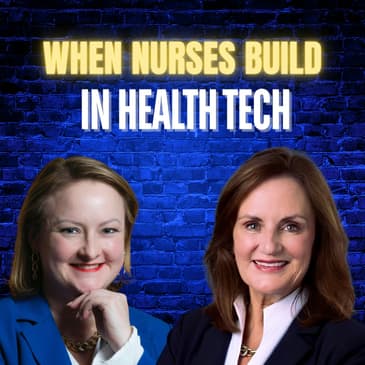
What happens when a critical care nurse becomes the executive building the tools she once struggled with?
Susan Grant, DNP and Chief Clinical Officer at Symplr, has lived both sides. She has navigated 3 a.m. staffing crises, chased credentialing deadlines, and wondered if the systems she used were built with nurses in mind at all. Now she builds those systems, and she is doing it differently.
In this episode, Rosa Hart sits down with Susan to unpack how AI-driven staffing tools, smarter scheduling, and nurse-led technology decisions can reduce burnout and bring predictability back to the bedside.
If you have ever felt like the tools you use every day were designed without you in the room, this one is for you.
In this episode:
- From critical care nurse to C-suite: Susan's leadership journey
- What Symplr does and why frontline nurses should know
- AI and predictive staffing: what nurses need to understand
- How to advocate for a seat at the tech decision table
- Credentialing, compliance, and cutting administrative burden
Burnout as a systems design problem. When technology works the way nurses actually work, the burden lifts. Susan and Rosa challenge the idea that burnout is only a staffing issue.
About Susan Grant Susan Grant, DNP, is the Chief Clinical Officer at Symplr, a healthcare operations software company specializing in workforce management, credentialing, compliance, and scheduling. She brings decades of clinical and executive experience to the mission of building technology that works for the people delivering care.
About Nurse Rosa's INsights Nurse Rosa's INsights is a nurse-led healthcare leadership and innovation podcast hosted by Rosa Hart, BSN, RN, SCRN. Each episode features evidence-based insights, expert interviews, and actionable strategies for nurses, healthcare professionals, system leaders, and advocates.
Topics covered include AI in nursing and health tech, clinical innovation, workforce sustainability, nursing leadership, healthcare policy, and the future of patient care.
Subscribe on Spotify, Apple Podcasts, YouTube, and all major platforms.
[00:00:01] I want to talk to my fellow nurses for a moment because this is important. I just finished reading Speak Up Start Now by Rosa Hart, RN, SCRN. And I'm telling you, for once someone said out loud what so many of us feel every day in health care, that we're waiting to feel ready, to feel confident enough to believe that our voices matter. This book shuts all of that down in the best possible way.
[00:00:26] Rosa doesn't just write from theory. She writes from lived experience at the bedside, in leadership, and in rooms where real decisions are made. And she reminds us, page after page, that imposter syndrome doesn't get the final say. We do.
[00:00:41] Speak Up Start Now gives you the tools to step into your voice with the confidence health care desperately needs from us. I'm recommending this book to every nurse, every new grad, every leader, and every person who's ever felt like their ideas weren't enough.
[00:00:59] Because the truth is, health care can't wait. And neither can we. The change we want to see starts with our voice. Your voice. Do yourself a favor. Get this book. Read it. And then go speak up. And start now. Speak Up Start Now by Rosa Hart, RN, SCRN. Available now.
[00:01:32] Hello and welcome to the Nurse Rosa's INsights Podcast. My guest today is Susan Grant. She's a DNP and Chief Clinical Officer at Simplr, which is an enterprise health care operations platform that's trusted by 9 out of 10 U.S. hospitals. It covers everything from workforce management and scheduling to credentialing, compliance, and quality.
[00:01:58] Simplr builds the infrastructure that helps health systems stop drowning in disconnected systems and start making decisions from a single source of truth. And Susan brings a clinical leadership lens to every product decision. Susan, welcome back to Nurse Rosa's Insights. Thank you, Rosa. I appreciate it. It's nice to be here with you.
[00:02:21] It was such a pleasure to meet you live at Vive in L.A. in February. And now it's May. We've been trying to align our schedules to get to have a longer conversation. So I'm so glad we finally did. Me too. Me too.
[00:02:37] So, you know, we met because you work at Simplr, but we really connected because we're both nurses. So could you share with me some of your nursing background and how, you know, your journey in health care? Yeah, thank you.
[00:02:54] Well, I started in critical care many years ago as a critical care nurse and had the privilege of working with patients who were awaiting heart transplants and did that for several years. And then just by, I think, just by happenstance because of a series of moves, ended up in leadership roles across the country.
[00:03:19] And in between that, pursued my master's degree in psych mental health nursing. And I did that because of my experience in heart transplant. It was back in the day when we were learning a lot about the physiological responses of patients with organ transplantation, but didn't know quite as much about the psychosocial piece. And so I was very aware of that, taking care of those patients.
[00:03:47] And I remember our first few patients experienced some psychosocial issues. And I was fascinated by that. And I thought, I need to learn more about that to help meet my patients' needs. So I pursued that master's degree in psych mental health. But over the years, I had moved into, as I said, I was a clinical nurse specialist for a period of time and actually moved into oncology at the time when I was a CNS.
[00:04:14] And through that experience, ended up at Dana-Farber Cancer Institute in Boston, where I went in as a, hoping to be a CNS at Dana-Farber, but ended up going down the management track instead and ultimately became the chief nursing officer there pretty early in my career. And something I had never planned on doing, but kind of fell into it, if you will.
[00:04:40] And then just had the privilege of serving at Dana-Farber for eight years and then going to University of Washington Medical Center in Seattle as chief nurse, the first magnet hospital in the country. And I had the honor of being the first DAISY CNO in the country and working with Bonnie and Mark Barnes, the just inspirational leaders behind the DAISY Foundation.
[00:05:03] And then Emory Healthcare in Atlanta as system chief nurse for 10 years, Beaumont in Michigan, Wellstar back in Atlanta, and now here at Simplr. So I spent 30 years as a chief nursing officer and chief nurse executive trying to help nurses create better work environments from that administrative end and health system end.
[00:05:28] And then had the honor of an opportunity to be a part of Simpler to kind of do it from the technology end. So that's what sparked my interest in going to Simpler was to take this from a different angle and how we can actually help improve the workflows for nurses via technology. Because we all know that a lot of the time in nursing, technology is thrown at you.
[00:05:56] And nurses aren't necessarily involved in those decisions about what it is and what it does. And it just makes life harder, it seems like. So I thought, no, I want to be on the side of making a difference in that space. So that's how I ended up. It's Simplr. Yeah, it sounds like you geographically crisscrossed the country. I did. You said over the course of like 30 years as a CNO. But how long have you been at Simpler now? I've been there almost 18 months now.
[00:06:26] Oh, okay. So pretty fresh then to the tech space, as it were, right? So you've really approached a lot of things from the perspective of the psychosocial effects, everything from your transplant patients to nurses and their need for encouragement and recognition, like with the DAISY Award. Absolutely. So do you see something like that in your work at Simpler?
[00:06:55] Or are you hoping to see something like that in your work at Simpler? I do see it, see that already at Simpler. You know, Simplr is an industry partner of the DAISY Foundation and vice versa. Simplr, the thing I really love about Simplr is that Simplr, yes, is about technology and software and very committed to improving workflows for nurses and clinicians in general so that they have more time with patients and families.
[00:07:24] But the other piece that Simplr does is, you know, Simplr wants to be a part of advancing nursing nationally beyond software. And so part of that partnership with the DAISY Foundation is really recognizing the value and what nurses contribute on a day-to-day basis to not only patient care but to health care in general. Yeah.
[00:07:49] And I think one of the functionalities we were talking about of Simpler was helping with scheduling and automating scheduling. Yeah. Because a lot of the times we'll pull some of the best nurses off of direct patient care to be charged nurses and then put them in charge of scheduling. Right. A whole bunch of people whose shifts are just this always moving web. So do you want to tell us a little bit about that? About the nurse scheduling? Yeah. Yeah.
[00:08:19] So the whole idea and premise around Simpler and their work around nurse scheduling is to make it more intuitive so that it is a tool that actually learns from people's behaviors and scheduling patterns. So it supports nurses on an individual basis. So you're not constantly going, okay, I need to fill out my schedule every six weeks.
[00:08:47] And you and I both know how much time that takes. But also to kind of create a connection in some ways, if that sounds, makes sense. It's that, oh, this scheduling system knows me. Right. And to say, oh, it's Susan again. Susan, we know that you can't work on Tuesdays or whatever that might be, or that you work X number of weekends or that you worked last Christmas and not going to work this Christmas based on the rules of your unit.
[00:09:15] So the individual piece of it. But also from a management nurse leader standpoint, nurse managers typically report that they spend at least 60% of their time with scheduling. And a lot of it, and I know this as a former nurse manager myself, most of my day really was spent on how many holes do we have in the schedule, taking time to figure that out. How many call-ins have we had? How many people do we need to find?
[00:09:45] Do we need staffing for this unit or that unit? And I was a nursing supervisor for many years, so I did it for our whole house. Now what Simpler is working toward and actually has in place is the ability to centralize staffing across not only a hospital, but an enterprise so that it's not that nurse manager having to figure it out or the nursing supervisor, but that that data is there in front of you
[00:10:12] and you can see a full view of your schedule and meet the patient care needs and also take into consideration nurses' needs as you do that. Only nurse managers, it seemed like, at least when I was coming up through the ranks, all of that information was buried and stored in the nurse manager's brain. Unfortunately. Right.
[00:10:37] And so like when you were talking about, oh, well, this system knows me, some people might get weirded out about anthropomorphizing technology, but how mad did they get at the real human who forgot they worked last Christmas? Why weren't they holding that in the forefront of their brain? Even though it was a big deal to me to work Christmas, right? And so I have to say, you know, why, why doesn't, you know, why doesn't my organization
[00:11:06] understand that I've already said these are my work commitments? Yeah. And it happens all the time with manual scheduling where people are like, yeah, I know you can never work Tuesdays, but we plugged you in because we didn't have anybody else to do it. Well, that's not a solution. And I think one thing I noticed about it when I was reading about it is that you're looking at the credentialing of the staff and like making sure that acuity based staffing is
[00:11:36] accounted for and that properly credentialed staff are reserved for on those units. It's like, especially like in stroke, we need to have a certain number of people who are able to respond to a code stroke, for example. That's right. So I really appreciate that. And, you know, that more and more we're seeing that organizations and it makes sense, right? So we went through a whole period in nursing and healthcare organizations where we had
[00:12:05] acuity systems. Nurses have never really liked acuity systems because they're never totally accurate. And, you know, it's very hard. And, you know, you have to have that nursing judgment still embedded in that. But the other piece of it is we used to look at staffing. And again, that information that has been held in your leader's head or your charge nurse
[00:12:30] or your nurse manager's head of, you know, if I have a cardiac intensive care unit, how many of my nurses are ECMO certified? Right. And what we're doing is we're taking competency beyond whether or not somebody is ACLS or BLS certified or that their license has not expired. So those are important things too. Those are important to keep track of as well. Yes. And I've been in organizations where we're like, oh my gosh, that person's not working
[00:13:00] because their license expired. Oh my gosh, they've been working for three weeks because they're, and their license has been expired. Right. What did we do before we had pop-up reminders and people? Exactly. People, like, certifications were in a binder that you had to, like, turn the pages of to see. Right. Or you'd have to go into the Board of Nursing website. I mean, it was a very manual process. Our system looks at that and has that information embedded in it.
[00:13:26] But on top of that, what we're seeing is that organizations are wanting to know how many stroke certified nurses are on. You know, when you need that team, you know, you look at housewide or how many for my ICU, you know, do we have for ECMO patients? The other piece that's really cool, I think, is using predictive analytics to say, okay,
[00:13:50] Susan, if you're a nurse manager and you have that cardiac ICU, you're looking forward and you're looking backwards, too, to say, what are the trends? What are my typical volumes at different times of the year? How many patients did I have that had, you know, had these needs or those needs? And trying to actually predictively say, you know what, here's what you're going to need in these months.
[00:14:18] And I recall at my last health system where I was chief nurse, we actually used the Simplr workforce solution, SmartSquare. And we were able to look at, and I remember I didn't have it in my prior organization. So when I had it at my last organization, I was so excited because we could actually proactively plan for the surges we had during flu season, during trauma season.
[00:14:48] We could look at kind of organizational behavior around staffing retrospectively around Mother's Day or Halloween, those days that people really want to have off. And so, and then plan accordingly to that. And is there a way you can manually enter in other things like if, I don't know, half of your staff of nurses are pregnant at the same time with different due dates and staggering their maternity leaves?
[00:15:17] Is there a way to enter in things like that that don't happen every year, but they're happening this year? There are ways to actually enter in, you know, information about projected leaves and that sort of thing or existing leaves. And so, so yeah. Because that's another puzzle to try to figure out. And it is a puzzle, right? I think I always say a good nurse manager is a person who loves to do puzzles because that's what staffing is.
[00:15:47] Well, kudos to them because that's a lot. And one last thing, Rose, I would say, you know, a good nurse manager, I think a good nurse manager nowadays has to do so much more than staffing. Oh, for sure. And what we've recognized is nurse managers can't be bogged down with staffing. You don't need to be an RN necessarily to do staffing. And so RNs are too valuable of a resource.
[00:16:12] And so really the idea is to give those RNs time back and managers time back so that they're not spending all of their precious and valuable time that they should be spending either in front of their team or in front of their patients and families. And so that's the goal in the end is to give them time back to spend time where it matters. Oh, definitely.
[00:16:40] I mean, staffing is a safety issue. You know, I mean, how are we supposed to take adequate care of patients if we don't have the right level of care to do it? And so many people, so many nurses, physicians experience burnout, not because they don't know what to do, but because of the moral injury of knowing what is possible and not being able to deliver on it because they don't have the resources and support to do it.
[00:17:07] So anything that can help make sure that you have the human support that you need in order to deliver on the care that you know how to give as long as you have enough bodies to do it, that is hugely important. I don't think it could be overstated. And we actually have reviewed data that actually supports that organizations.
[00:17:35] And I think the years were from 2021 through 24. And I'm not 100% on the years, but for three years, we looked retrospectively, SmartSquare, our leaders in SmartSquare looked at the NSI database to look at clients that were using
[00:17:59] or participants in the database that were using SmartSquare compared to those who are not over that period of time. And those SmartSquare clients actually have a lower percentage of burnout or lower turnover rate than the other organizations. Now, that's important data.
[00:18:20] So we're really trying to invest in looking at those type of metrics and to drill down into those metrics because we do know that organizations can't just willy-nilly decide on different solutions anymore. First of all, they're far too expensive. And second, you know, the goals around much of the technology we're seeing now from healthcare systems
[00:18:46] is to look at what are those things that actually reduce burnout, take that cognitive burden off of our clinicians and make life easier. And so we're really investing in the metrics to actually show that return on investment as they invest in these products. That sounds like a convincing argument right there if you're not having your people leaving all the time because they're too strapped.
[00:19:16] Going back to this is kind of a change in career path for you in more of the tech world. Is there anything that has surprised you entering into this realm from your clinical background? You know, it may sound funny, but the thing that surprised me most, well, first of all, I didn't know near as much as I probably should have as a nurse leader about technology.
[00:19:45] And now having seen it from the other side, now I'm like, gosh, I would want to know this, this, this. You know, I really, I've learned so much. And now I realize how important it is that we as educate ourselves around technology, the use of technology, evaluating technology, and especially with AI too. And to really, you know, I used to have a boss who said, you have to sharpen your elbows sometimes
[00:20:15] and make room for yourself at the table. We've got to do that when it comes to technology and AI. So that's one big learning. The other one, though, that I think as a nurse leader, I think because technology companies, a lot of the time are constantly trying to get together with you and connect with you to share what their products do.
[00:20:42] And I think for a period of time, I think it's changed now, but for a period of time in the past, they were vendors, they weren't really partners. So I viewed technology companies as, oh my gosh, I don't want to talk to them. And because all they want to do is sell. And my big learning coming into Simpler has been, you know, as I've met people at Simpler,
[00:21:09] there are some of the most dedicated people who want to make a difference in the lives of nurses and clinicians to make their lives easier, just as there are on the health system end of people who want to make a difference in their patients' lives. I had, I was talking to one of our user experience people. She's just amazing. And I thought, okay, yeah, I'm going to meet with the user experience people.
[00:21:39] And she was telling me something about our scheduling solution. And I said, you know what? I've actually met with some of our, you know, customers who are, you know, sharing information about what helps, what doesn't, and the customer experience. And I said, you know, they love this feature. It has really made a big difference. And she sat back and she got choked up and she goes, you have no idea how that makes me feel.
[00:22:09] It makes me feel like I've really done something important. And she goes, that's what I come out to do every day. And I thought, wow, you know, we all want to make a difference. I think that was my biggest learning. And I, maybe I thought, well, you know, of course nurses want to make a difference every day. But coming in to Simpler and, you know, meeting some of the folks, it has been really inspiring to see how hard they work to make it right.
[00:22:38] And they've spent time with clients. They, they're always looking for people to talk with, to say, I want to know what people, what nurses would think about this, this or that. So it really, it's, it's exciting to see that. And it's funny, you mentioned feeling like they're vendors. I had to fill out a Simplr application in order to become a vendor, to go into a system as a media consultant. Okay. Yep. Isn't that not? Okay. That's funny.
[00:23:08] Did you, you joined the gatekeeper? Yes, yes, I guess we did. It's pretty cool. So are you working on building anything new right now that you can tell us about, that you're excited about? Yeah, we actually, I mentioned artificial intelligence. And we have development partners, one in particular, where they are working with us
[00:23:34] and we're working with them to create different predictive models and to use AI in a way that, again, cuts out a number of steps in the scheduling process for managers in particular. That saves them time. And so one of those things is looking at, you know how when a schedule comes out or when a manager, I don't know if you've ever had to be the lead on a schedule.
[00:24:03] I have not had to make a schedule for anyone. So a lot of the time, most organizations, they'll have somebody, which is usually the manager, or will be working on the schedule. You get everybody kind of settled and fit as much as you can, but you turn it into the manager with sometimes holes that could not be reconciled. And a lot of the time it's because you're doing it manually.
[00:24:29] You don't know necessarily things like out of those 80 people, who's not working their full complement of their FTE or who actually would be available to work this day versus that day. Those types of things are who's going to be off or not off and or who changed their schedule and they can actually work. Those types of things that help you balance the schedule, the manager ends up having to do that or somebody does.
[00:24:59] So it's another step and it's time, time, and it's cognitive burden. What we're doing and working on is using AI to actually put together a balanced schedule for the manager so that it's balanced when it comes out. And what we've heard from our partners is that if we can do this, this, and I know as a manager, as a former manager, that would be huge.
[00:25:28] And so we're going to do it. And so by the end of this year, we should have that functionality embedded in our system. So we're very excited about that. We're working on, you know, again, further developing the whole competency piece that you and I talked about. You know, how great would it be that you'd be able to look at the schedule and say, oh, no, there are the right number,
[00:25:52] not only the right number of nurses and nursing assistants and whoever else is on your team, but all of the competency that all of these competencies that these people have are the right set of competencies. And take into consideration how many new grads you have on, whether or not you have too many new grads versus seasoned folks. Right. That is so important because you throw a bunch of new grads out there
[00:26:18] and they don't have those experienced nurses to learn from on the job. That's just going to set them up to want to leave because it's not safe. And they won't feel safe. And you're so right, Rosa, because I know as a former nurse exec, when I would talk with our nursing staff, I'd round regularly in our different hospitals. And the number one thing every single time was,
[00:26:48] I wouldn't be leaving if we had the right staffing. Yeah. I wouldn't be leaving. And a lot of the time they were not leaving to go somewhere else. They were leaving to get out because they couldn't handle it any longer. And kind of goes back to what you were saying. Nurses come in every day to, it's in their soul about making, doing what's right and doing what's needed for their patients.
[00:27:15] And when you leave and you haven't been able to fulfill that, it wears on you over time. And so, so I, I couldn't agree with you more. And I think a lot of people learned through travel nursing and things like that over the course of the pandemic, what else is out there. And yet at the same time, like you said, if they're leaving the profession, they're not leaving to go work at another hospital.
[00:27:41] They're leaving because they're leaving nursing because they don't believe it is better anywhere else at neighboring hospital over there. They might pay different, but they can't pay enough for the level of trauma that is happening. And I did have a thought also, when we were talking about solutions,
[00:28:06] that I had a friend who had gone to a nurse hackathon at a conference of nurse leaders. And she said they were getting up to share about the solutions they had come up with over the course of the hackathon. And the solutions already existed. And these nurse leaders were completely unaware of it.
[00:28:30] So that's another thing that I feel like really breaks my heart is that barrier you were talking about of feeling like, Oh, those are salespeople. I don't want to talk to them, but how as nurses, can we educate other nurses on the available solutions that, you know, and kind of get over that barrier, you know, have you found,
[00:28:55] have you been able to like speak at nursing conferences and kind of like overcome that wall? Or what do you feel like is an effective way to reach people? Yeah, I think, you know, I've seen different organizations do it differently. There are a number of ways to do it. And I think it all starts, and I always go back whenever I speak about this, it all starts with having nursing at the table, not after the solution has been selected,
[00:29:24] but in the beginning of the RFP process. Nurses, a lot of the time, can actually make an RFP even better because they're able to clearly define what the problem is that the organization is trying to solve. for by looking at certain technologies. IT is great, but they can't do that themselves if it's a solution that's primarily used by nursing. They just can't. And they're the first to say it.
[00:29:54] I think getting involved right at the get-go, I think the chief nurse has a major role in that, and also engaging nurses within their organizations to not only inform that process, but then to be at the table once the product, well, in weighing in on which product to select, but once that is selected, nurses need to be at the table to talk about,
[00:30:22] how are we going to know that this solution has made a difference? So those metrics, be very clear about what is that problem we're trying to solve for, but then also to your question, in the education and implementation of the solution, adoption will be far better, and nurses will be far more aware of the capabilities of the solution if they are involved in the process. And in fact,
[00:30:51] they become your greatest champions. So it's really critical. And the only other thing I'd say, because I think we hear a lot, nurses have to be at the table, nurses have to be at the table. Yes. But if we're going to put nurses at the table, we also as an organization, and as nurse leaders need to be prepared to help nurses be prepared to sit at the table. It kind of goes back to what you were saying about, you know, a good nurse all of a sudden is put into a manager role.
[00:31:20] Because they're a good nurse. We know now that's not how to do it, right? You have to have certain skills to be a nurse manager. And not every outstanding nurse is the best person to be a nurse manager. It's the same thing with sitting at the table around making these decisions about technology. We all have people in our organizations who are very passionate and are at the bedside, and they're constantly looking at workflows. They're constantly going, you know, if we did it this way or that way, and they're brilliant.
[00:31:50] They're brilliant. They have all of the answers. I'm convinced of it. So, you know, if we can get those very curious and eager people and help educate them on, here are the things you need to be thinking about when you are at the table talking about new technologies for our organization, and equip them to be a part of that conversation. There's no telling. All I can say is we will end up in a good place.
[00:32:20] So, I think we have to take that into consideration. How do we engage? We have to engage in a very thoughtful, strategic way. Right. And so, in case a nurse who is really good at solving workflow issues, wants to be involved, but may not have the time or inclination to go get an MBA before joining these conversations,
[00:32:46] are there a couple of tips that you would give us to what they can be thinking about when bringing those solutions? You bet. First of all, you don't need an MBA. You don't need to go back to school to do this, to be a part of the organization. I would say, remember, you, as the direct caregiver, you've got the answers. You don't have to go to school for that. You've got the degree in direct care and workflows. It may not be a formal one, but trust me, you've got it. So,
[00:33:14] take that information and trust that you know. You do know. And so, the other piece, so I would say, trust yourself and trust that you've got that information. No one knows those workflows better than you do, especially folks who are in admin. I mean, I'll say it. I can say it because I was a CNO. Your CNO doesn't know the workflows the way you do. Your manager doesn't even know the workflows the way you do. Only you do. So, there's that.
[00:33:43] The other piece is that AONL, the Association of Ambulatory Care Nurses, ANA, all of our organizations, NCI, AACN, all of them, have resources that you can tap into. If you're a member, you do have to be a member, but that's it. That's the only money you have to put forward to be a member. They have resources where you can educate yourself on these different tools, tools on AI, and all the things you need to know.
[00:34:13] But then also, don't be shy about saying to your manager or your director or your CNO, I want to be involved. Can you help me be involved? And hold them to it. So, that would be my advice. That's awesome. Well, thank you for that, Susan. And this brings us to the billion dollar question that I ask every guest on Nurse Rosa's Insights. Are you ready for this? Okay, I'm ready. I'm bracing myself. If you were given a grant, Susan,
[00:34:43] for one billion dollars to meet a need you see in healthcare, how would you like to see it used strategically to have the most sustainable impact? You know, you teed me up perfectly. I think right now, in this time right now, I'm not saying in the past or perhaps in the future, but right now,
[00:35:04] I would use it to educate the nursing workforce to learn and to navigate their systems and ensuring their voice is heard when it comes to technology and AI and to help equip them to be better participants in those dialogues. That's what I would do. Well, that's awesome.
[00:35:30] Would you give that billion dollars to those organizations that you listed out as the source of that education or what methodology would you employ to get them knowledgeable in the way you're describing? I think that is one way I would, you said it's a billion or a million. Billion with a B, okay. All right. Billion. Then I would give the organizations by float away if you give them a billion dollars. Well, we can spread. I want to know how far my money's going to go.
[00:36:00] So I would actually give some of those, I would give those organizations funding, but I would also give health systems funding. There are some amazing health systems out there who are very invested in making this happen, but they can't and they don't have the funding. And so I would want to be able to make it available across the country, across organizations. And I'd also want to make it available on an individual basis.
[00:36:26] I know I've been involved in trying to disperse funding and when it's limited and it's hard to do that, but I think I would try to make it available to as many people who really needed it and wanted it and had thoughts about how to use it. I'd want to make it available to them as well. So not only the formal professional organizations, but I think also healthcare systems and schools,
[00:36:54] I would definitely make it available to schools as well. Our schools need that. And I think they need support and funding and hiring faculty who can actually teach that. So, you know, they, they want to do it. It's just about how do they, how do they pull people in and have the funding to do it? That's so true. Awesome. Well, thank you, Susan. And I really appreciate the work that you're doing to represent nurses in industry
[00:37:22] and to encourage other nurses to jump in and participate as well. So if anyone is listening to this and they would like to reach out to you, is LinkedIn the best way to do it? Yes, that would be great. I'm always looking at, oh, I look at it regularly. I won't say always, but I look at it regularly for sure. That's a good way to reach out. Yeah, definitely. And if they want to learn more about Simpler, they can go to S-Y-M-P-L-R dot com. Is that right?
[00:37:53] S-Y-M-P-L-R. No, no. We added an E. Okay. That's okay. That's okay. It's a little bit of a different spelling. Well, people try to do that to both of my names all the time. Rosa Hart, neither of which have an E, and people try to put an E in both of them. So here I go making the same mistake people do to me all the time. That's okay. That's okay. All right.
[00:38:16] And then for our listeners, if you enjoyed this episode of the Nurse Rosa's Insights podcast, please be sure to like and subscribe wherever you're listening, or if you're watching on YouTube. And I will see you in the next episode. Thank you so much, Rosa. Thank you.